
You press play, hear three seconds of yourself, and stop the recording. Who is that? Because it is definitely not you.
I've spent over twenty years working as a professional actor. Sound stages, dubbing booths, self-tapes recorded at midnight in my hallway. And I can still remember the first time I heard my own voice played back — leaning toward the speaker, absolutely certain something was wrong with the recording.
Nothing was wrong with the recording.
If you hate the sound of your own voice, I want you to know two things right away. First: you are not vain, broken, or uniquely cursed. Second: there is a real, physical, almost boring reason your recorded voice sounds like a stranger wearing your face — and once you understand it, the cringe starts losing its grip on you.
That's what this post is. Not a pep talk. An honest explanation, and then a way through. Because the people you're meant to reach need your voice exactly as it is — the one on the recording. The one, as it turns out, they already know.
Not sure what to film next? Creative Compass builds the plan with you.
The honest physics: why you hate the sound of your own voice
Here's what's actually happening when you speak, and I promise it helps to know.
You hear yourself through two channels at once. One is the air — sound waves leaving your mouth, travelling through the room, arriving at your ears the same way they arrive at everyone else's. The other channel is your own body. Your vocal cords vibrate the bones of your skull, and bone carries that vibration straight to your inner ear. Bone conduction favours the low frequencies, so it adds depth. Warmth. Resonance.
So the voice you've heard your entire life — the one you think of as my voice — is actually a duet. Air plus bone. Lower, rounder, and richer than what anyone else has ever heard.
A recording strips the bone away. Air only. That's why playback sounds thinner and higher and just… off. Not because the microphone is lying to you. Because your skull has been quietly sweetening the mix since the day you were born.
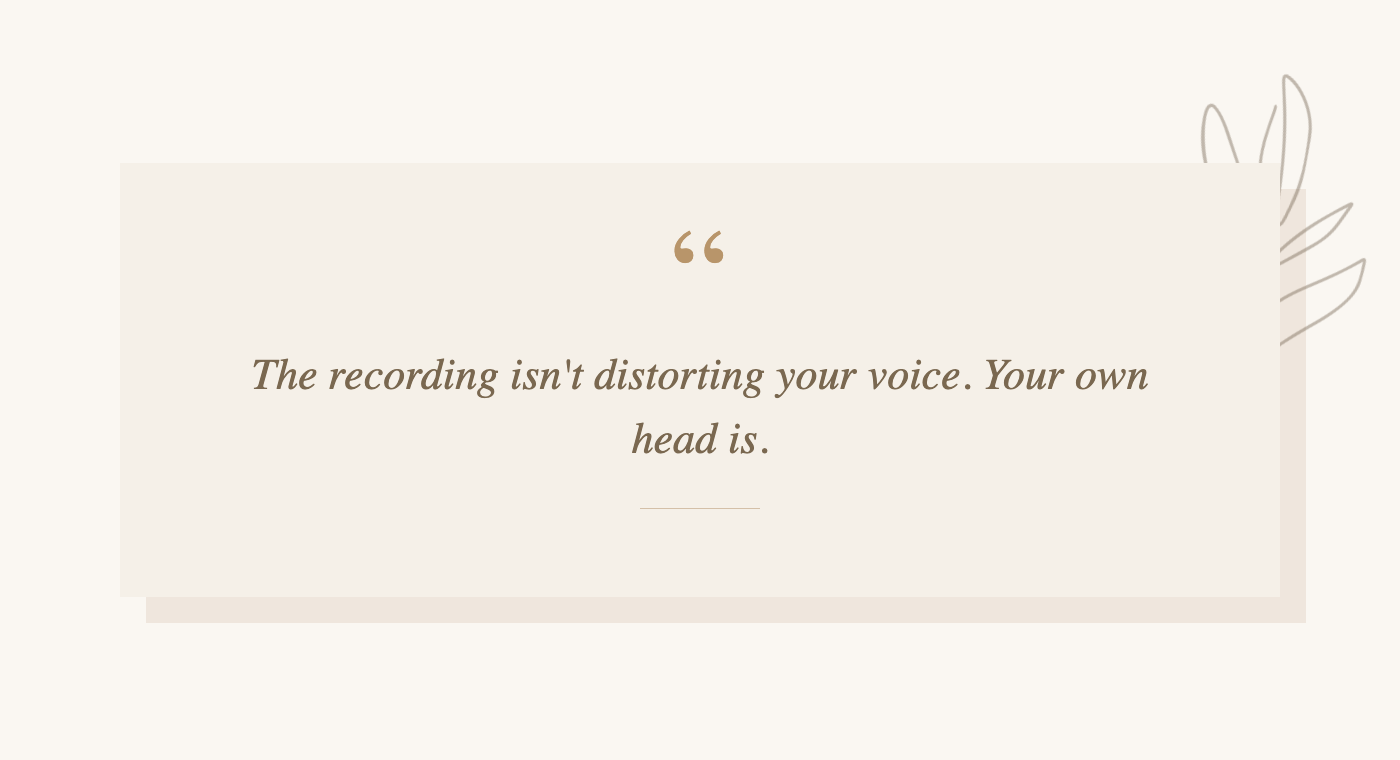
Read that again if you need to: the recording isn't distorting your voice. Your own head is. The playback version is the accurate one — the one the world has been hearing all along.
Voice confrontation is real — and everyone has it
There's actually a name for this feeling. Researchers call it voice confrontation, and they've been studying it since the 1960s — that jolt of discomfort when people hear a recording of themselves and don't recognize what they hear.
And I do mean everyone. Actors who make their living with their voices flinch at their own playback. Singers feel it. Broadcasters feel it. The person whose voicemail greeting you think sounds effortless? They probably re-recorded it four times and still winced.
Part of it is the physics we just talked about. But part of it is deeper. Your voice feels like you in a way almost nothing else does. It carries your moods, your history, the place you grew up. So when the recording doesn't match your inner picture, it doesn't feel like a small audio difference. It feels like being told your reflection has been wrong your whole life.
No wonder you flinch. That's not vanity. That's your identity doing a double take.
But here's the part that changes everything, if you let it sink in.
The voice you cringe at is the one they already love
Every person who has ever loved talking to you — your best friend on a long phone call, your mom, the client who said "this conversation was exactly what I needed" — has only ever heard the recording version.
The air-only voice. The one you just hit stop on.
They never got the warm bass boost your skull gives you. They've been listening to playback-you from the very beginning, and they kept calling back. They leaned in. They asked you questions just to keep you talking.
So when you cringe at a recording, you're not discovering some awful truth the world has been politely ignoring. You're just meeting, for the first time, the voice everyone else already knows and likes. The stranger in the recording has friends. Lots of them.
You're the only person on Earth who's still getting used to her.
How familiarity dissolves the cringe
Understanding the physics takes the shame out. But understanding alone doesn't make playback comfortable — familiarity does. We warm to what we hear often; the discomfort isn't a verdict on your voice, it's a measure of how new it still is to you. Which means it's not fixed. It fades with exposure, the way any unfamiliar thing does.
Here are the three practices I come back to again and again. None of them require courage in bulk. Just small, repeatable doses.
1. Send voice notes every day
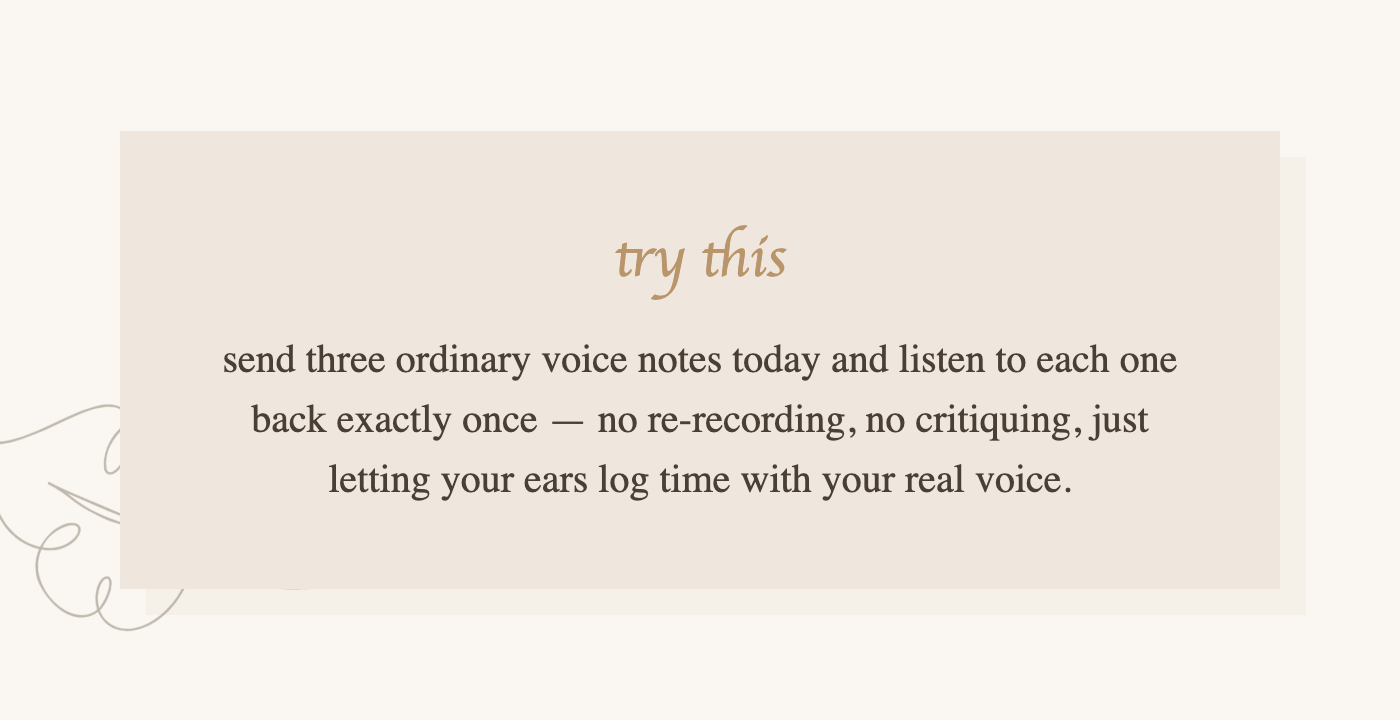
Not videos. Not content. Just ordinary voice notes to people you'd text anyway. "Running five minutes late." "Saw this and thought of you." Ten seconds each.
Then — this is the actual practice — listen to each one back once before or after you send it. One listen. No re-recording, no judging, no deleting unless you actually misspoke. You're not performing. You're just letting your ears log hours with your real voice, the way you'd get used to a new haircut by walking past mirrors.
Most people notice the flinch getting quieter within a couple of weeks. Not gone — quieter. That's the win.
2. Listen for the message, not the sound
When you do listen back, give your brain a job — because if you don't, it will default to auditioning your voice. Instead, ask: Did I say what I meant? Was I clear? Would the person receiving this feel what I wanted them to feel?
This one shift moves you from critic to communicator. The sound of your voice is not the point of your voice. The point is what it carries. When you grade the message instead of the tone, two things happen: the listening stops hurting so much, and you actually start getting better at saying what you mean.
3. Record while talking to one person you love
You tense up when you speak into a device because you're talking to a lens, a mic, a void. So don't. Before you press record, picture one specific person you love talking to — and say it to them.
Your voice knows how to do this. It softens, it warms, it finds its natural rhythm, because that's the register it has used in every good conversation of your life. And here's the quiet bonus: when you listen back to a recording where you were genuinely talking to someone, it sounds less like a stranger. Because that is you. The connected you.
If your struggle is less about the sound and more about the sight — the freeze-frame of your own face — I wrote a whole companion piece on how to watch yourself on video without cringing. The two cringes are cousins, and they respond to the same gentleness.
What it sounds like on the other side
I want you to hear what happens when someone stops fighting their own voice and starts using it again. A member put it this way after one of our video trainings:
"Today's video training was amazing!! Thank you Elfina!!!! I haven't recorded a video in I can't remember when! Not only did I record 5 videos but I tapped back into WHY I want to record videos!! Five stars all the way!"
— A.N.
Notice what shifted. Not her voice — her voice was the same at the end of that day as it was at the beginning. What shifted was where her attention went. Off the sound. Back onto the why. Five videos followed, almost by themselves.
That's the pattern I see over and over: the moment the message becomes louder than the self-monitoring, the voice takes care of itself.
The myth that keeps you stuck
Let's name the belief underneath all of this, because it's almost never said out loud:
"When people hear my recordings, they hear what I hear — and they cringe like I do."
They don't. They can't. Remember: playback-you is the only you they have ever known. There is no "real" richer voice they're comparing it to — that version exists only inside your skull. The gap that makes you flinch is invisible to every other human being, because they're standing on the other side of it.
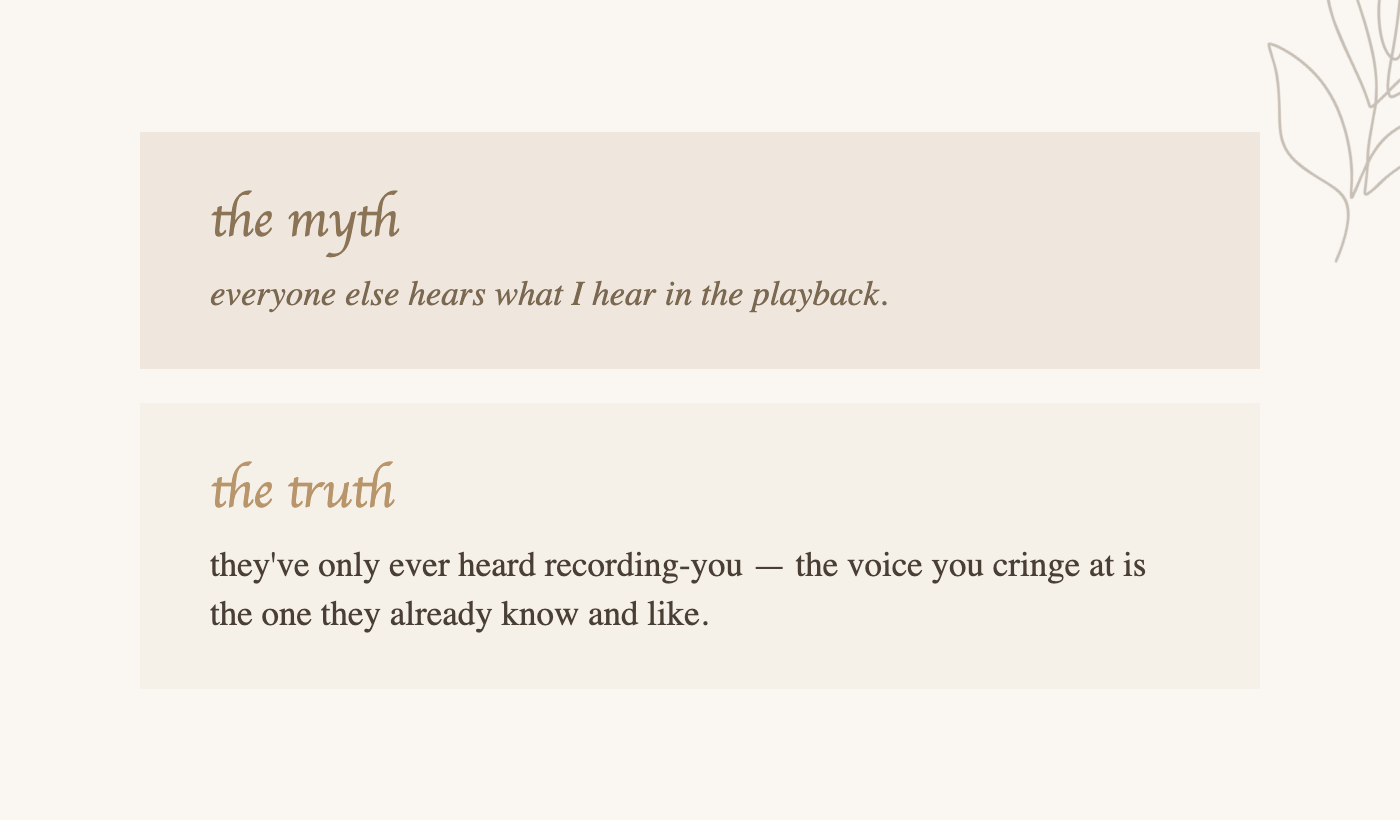
So the next time you hate the sound of your own voice on a recording, try saying this to yourself: this is the voice my favourite people already love. I'm just the last one to meet it.
Your voice was never the problem
Here's where I'll leave you. The cringe you feel at playback is not information about your voice. It's information about how new the accurate version still is to your own ears — and newness wears off. Every voice note, every single listen-back, every recording where you talked to one person you love instead of a lens… it all counts. It all compounds.
And if you're wondering what's really underneath your particular flavour of camera-shyness — whether it's the sound, the sight, or something quieter — take the Camera Confidence Zone quiz. It takes a few minutes, and it'll show you exactly where you are on the journey and what to practise next.
Your message needs a voice. It already has a good one.
Be seen. Be heard. Be authentically you.
The more you hear yourself on purpose, the less strange it gets. Compass gives you something to record each week, so the hearing happens by habit instead of by accident.
See How It Works