
You filmed the video. That was the hard part, you thought. Then came the moment you had to watch it back.
I hear a version of this sentence almost every week: "I can record the video, Elfina. I just can't watch it. I hate watching myself on video so much that the file sits there for days."
And the person saying it always looks a little embarrassed. Like this is a confession. Like everyone else on the internet is happily reviewing their own footage with a cup of tea.
They're not. I've been a professional actor for over twenty years, and I'll tell you a set secret: plenty of working actors — people you've watched, people with long careers — quietly avoid their own work. The comfortable-on-camera people you admire were not born able to watch themselves. Most of them just built a way to do it that doesn't hurt.
That's what I want to give you today. Not "just get over it." An actual protocol — the same gentle, structured way of watching footage that I use and teach — so playback stops being an ambush and starts being useful.
Not sure what to film next? Creative Compass builds the plan with you.
First, let's name the cringe honestly
The cringe is not vanity. I need you to hear that, because most people carry a second layer of shame about it — I hate watching myself on video, AND I'm shallow for caring. Drop the second layer. It's not true.
The cringe is self-protection. When you watch your own footage, your brain treats it as a social risk: this is how the tribe sees me, and if something's wrong, I need to find it before they do. So it scans for flaws with an intensity it would never aim at another human being. You wouldn't watch a friend's video the way you watch your own. You'd just… watch it. Hear what she said. Notice her warmth.
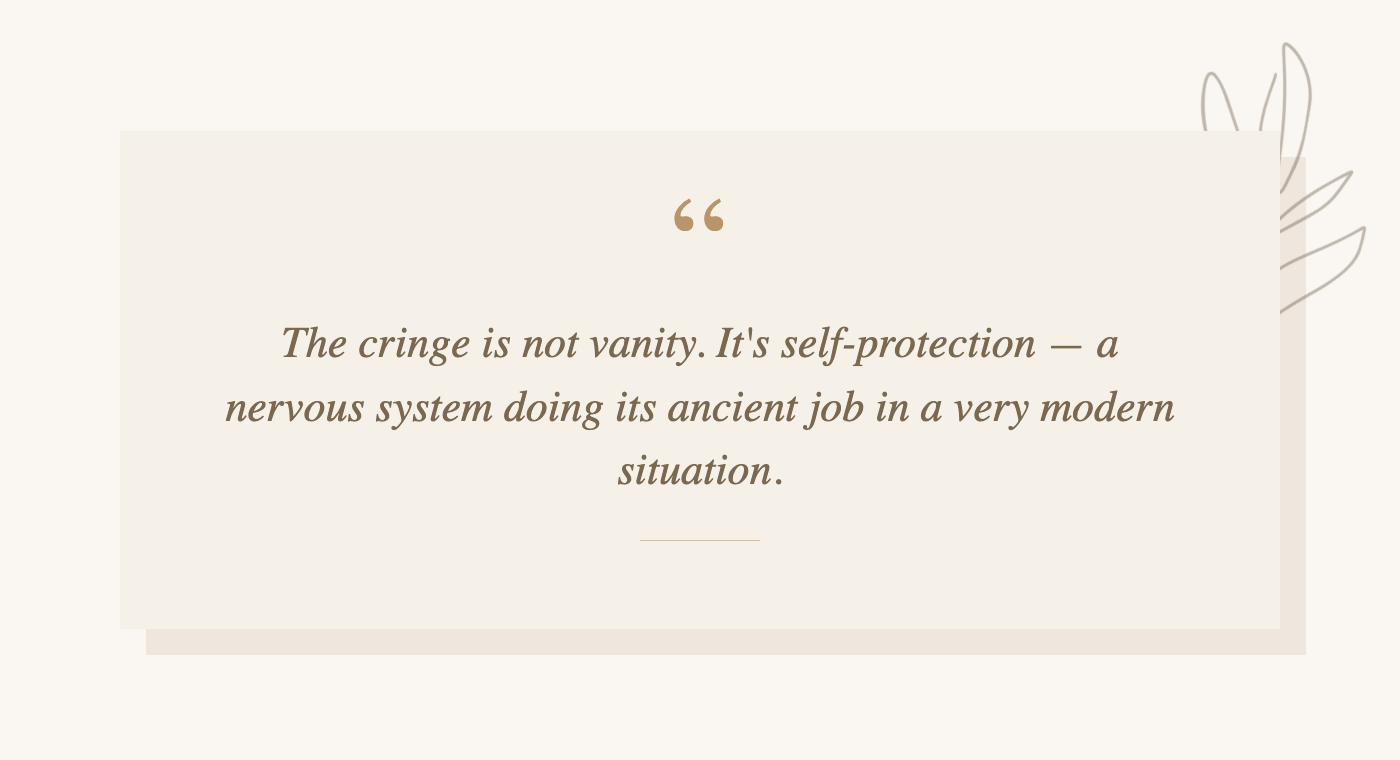
For yourself, the volume on the threat-detector goes all the way up. That's not a character flaw. That's a nervous system doing its ancient job in a very modern situation.
Which means the goal is not to make the detector love what it sees. The goal is to give it better instructions.
Why you hate watching yourself on video: the mirror problem
There's a second thing stacking the deck against you, and almost nobody talks about it.
You have spent your whole life looking at yourself in mirrors. Every mirror flips you. The face you know best — the one your brain has filed under me — is the reversed one. Your part falls on the other side. Your smile pulls the other way. Every small, normal asymmetry sits where you expect it.
Video doesn't flip you. A camera shows you the unmirrored version — the face every other person in your life sees every day. To them, it's simply you. To you, it's you… shifted. Slightly wrong in a way you can feel but can't name.
Psychologists call the underlying principle the mere-exposure effect: we prefer what we've seen most often. You've logged tens of thousands of hours with mirror-you and almost none with camera-you. Of course the footage feels off. It's not showing you a worse face. It's showing you a less familiar one.
And if the sound in the playback bothers you as much as the sight — same story, different sense. I wrote about the physics of that in why you hate the sound of your own voice. Between the flipped face and the missing bone-conduction warmth, playback hands you a stranger. No wonder you flinch.
Familiarity is the cure for both. So let's build it — carefully.
The watching protocol: two passes, one rule
Here is exactly how I want you to watch your next video. Not someday. The next one you film.
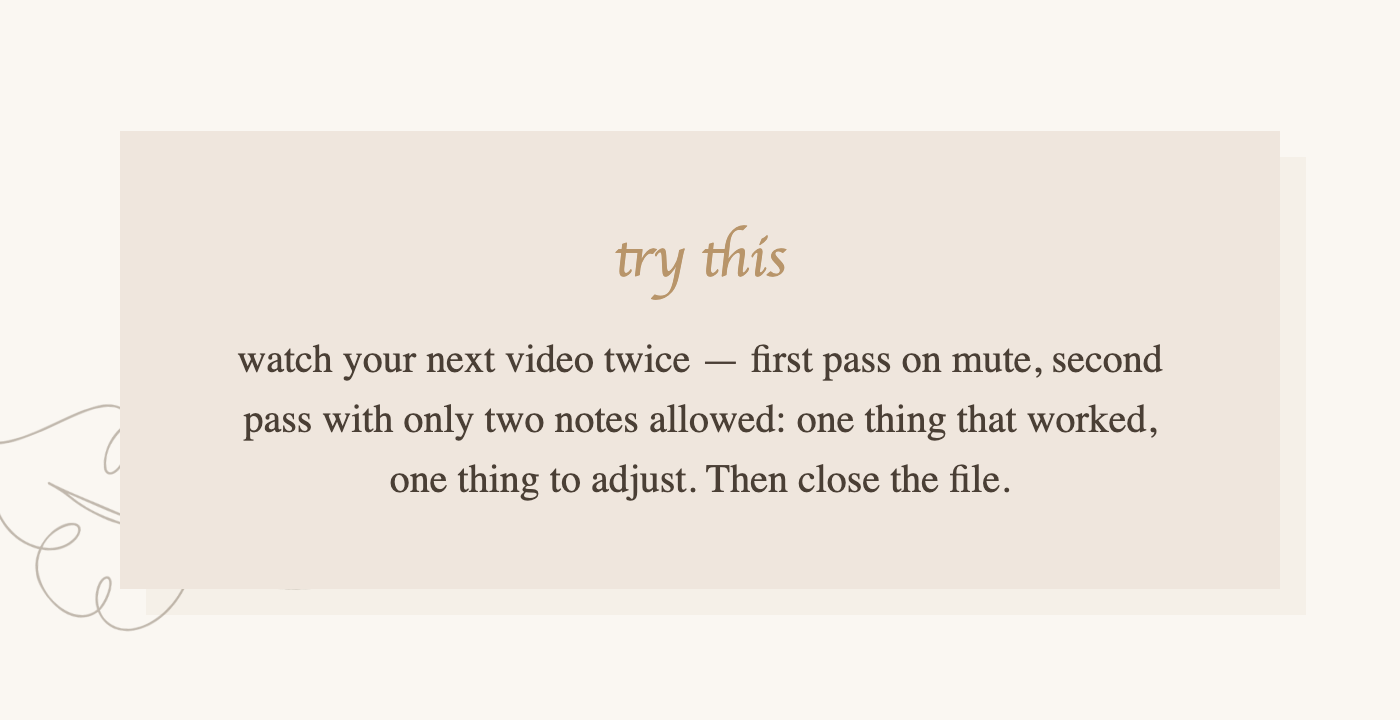
Pass one: sound off
Watch it once on mute.
This sounds too simple to matter, and it changes everything. With the sound off, you can't spiral about your voice, your ums, your word choices — your brain only has one channel to process, and the threat level drops by half. You'll notice things you never see when you're braced: that you smile more than you thought. That your hands are expressive. That you look, from the outside, like a person having a conversation — not like the trembling mess you felt like inside.
That gap — between how filming felt and how it looks — is one of the most reassuring discoveries a nervous person can make. The camera almost never shows the nerves at the volume you felt them.
Pass two: watch as a coach, not a critic
Now watch it again with sound, but before you press play, give yourself a job with exactly two questions:
- One thing that worked. A moment where you were clear, warm, natural, or genuinely yourself. Find it. Say it out loud or write it down. This is not optional fluff — it's training your attention to register evidence, because your brain will not volunteer it.
- One thing to adjust. One. Not seven. "I'll slow down my first sentence." "I'll look up before I start talking." A single, kind, specific note — the kind a good coach gives, the kind you could actually use tomorrow.
A critic watches to render a verdict on you. A coach watches to make the next take easier. Same footage, completely different experience — and only one of them ever made anyone better.
The one rule: never frame-by-frame
Do not scrub. Do not pause on your own face. Do not screenshot the weird mid-blink frame and study it.
Nobody — nobody — experiences you in freeze-frame. Human beings watch each other in motion, at full speed, while mostly thinking about themselves. When you pause on a single frame, you're inspecting a version of you that has never existed for anyone else, and you're handing your threat-detector a microscope. Watch at normal speed, all the way through, and let the video be what it actually is: a moving, talking, breathing person.
Two passes. Two notes. No scrubbing. Then close the file and go live your life. The whole protocol takes less time than the dread does.
What "success" actually looks like
Here's the recalibration that sets people free: the goal is not to love watching yourself.
Neutral. That's the goal. You watch the footage the way a pilot reads instruments — a little interested, a little detached, looking for information. Some days you'll even catch a flicker of "oh, that was good." Lovely. But you don't need it. Neutral is enough to publish, enough to improve, enough to build a body of work while other people wait to feel ready.
A member, Tina, described crossing that line better than I ever could:
"When I first got here, I was a total newbie — super intimidated by being on camera and didn't even know how to operate my own camera phone! But thanks to Elfina's guidance, I've learned so much. The biggest shift? I recorded a one-take video on a Facebook group and I actually liked it. Authentically You has lived up to its name for me. ~ Tina 💜"
"I actually liked it." Notice her own surprise in that sentence. She didn't get there by forcing positivity — she got there through reps, structure, and watching herself with kinder instructions until the stranger on screen became familiar. The liking arrived on its own, later, as a bonus.
The myth of the confident creator
Now for the belief that keeps the cringe in business:
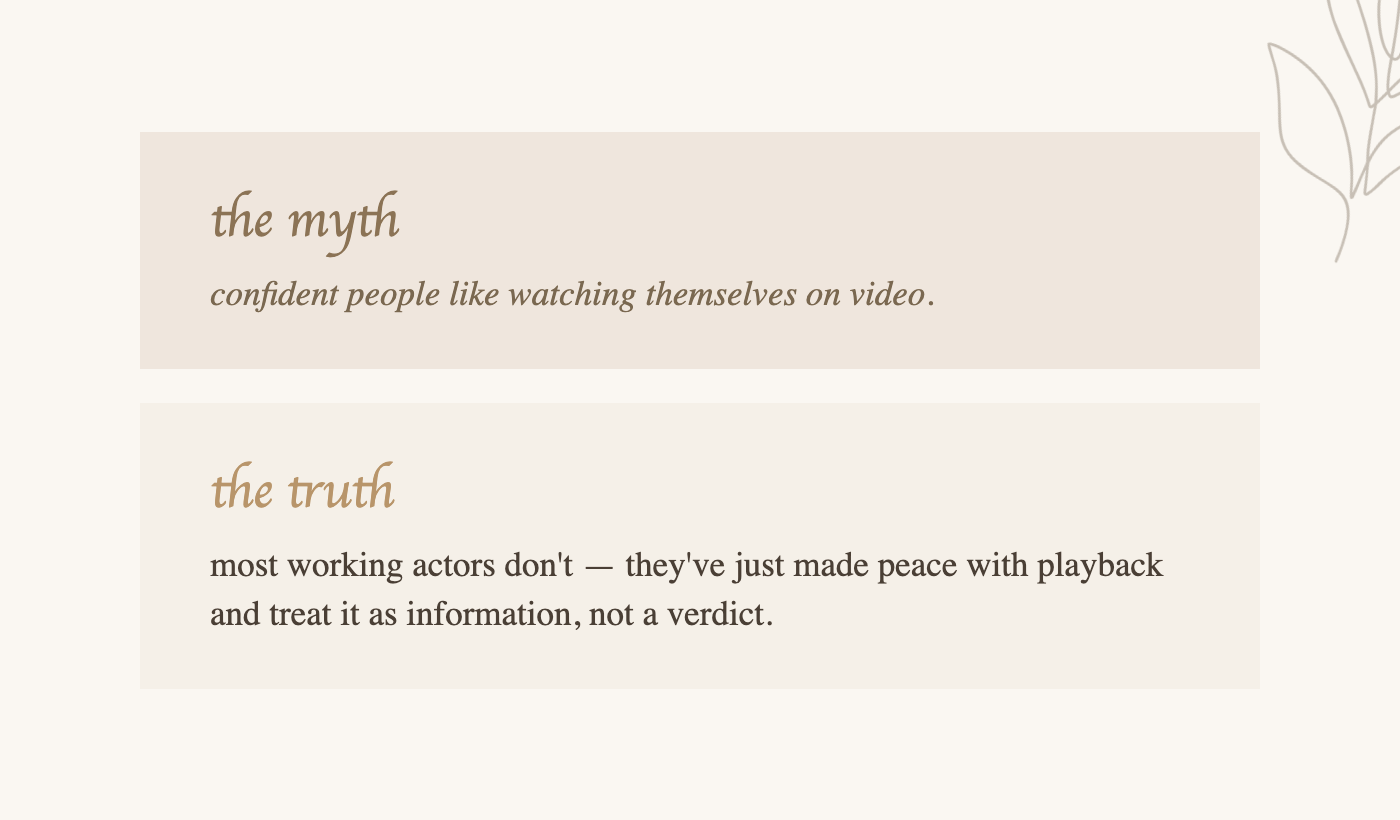
"Confident people enjoy watching themselves. Since I hate it, I must not be built for this."
I've spent two decades around some of the most on-camera-comfortable people in the world, and I can tell you: most working actors don't like watching themselves either. Some avoid their own films entirely. What they have isn't enjoyment — it's peace. They've made an arrangement with playback: it's information, not a mirror of their worth. They watch (or don't), they take the note, they move on to the next take.
So if you hate watching yourself on video, you haven't failed a confidence test. You're standing exactly where nearly everyone stands — including the professionals. The only difference between you and them is a protocol and some reps. Both of which you now have.
The file is not a verdict
The next video you film, try the whole thing: one pass on mute, one pass as a coach, two notes, no scrubbing, close the file. Notice that you survived. Notice, maybe, that it was ten percent less awful than you braced for. That ten percent is the whole game — it compounds every single time you do it.
Because the person in that footage isn't a problem to be fixed. She's just someone you haven't spent enough time with yet. And the more you watch her in motion — kindly, briefly, at full speed — the more she starts looking like what she's been all along.
You.
And when you're ready to go one layer deeper — past watching yourself and into actually feeling like yourself while the camera rolls — that's a different skill, and it's learnable too. I wrote about it in how to be yourself on camera. It's the difference between performing and connecting, and it changes everything downstream — including how playback feels.
Be seen. Be heard. Be authentically you.
Watching back gets easier when you know what you were aiming for. Compass gives you the plan before you film, so there's something to measure against instead of just a feeling.
See How It Works