
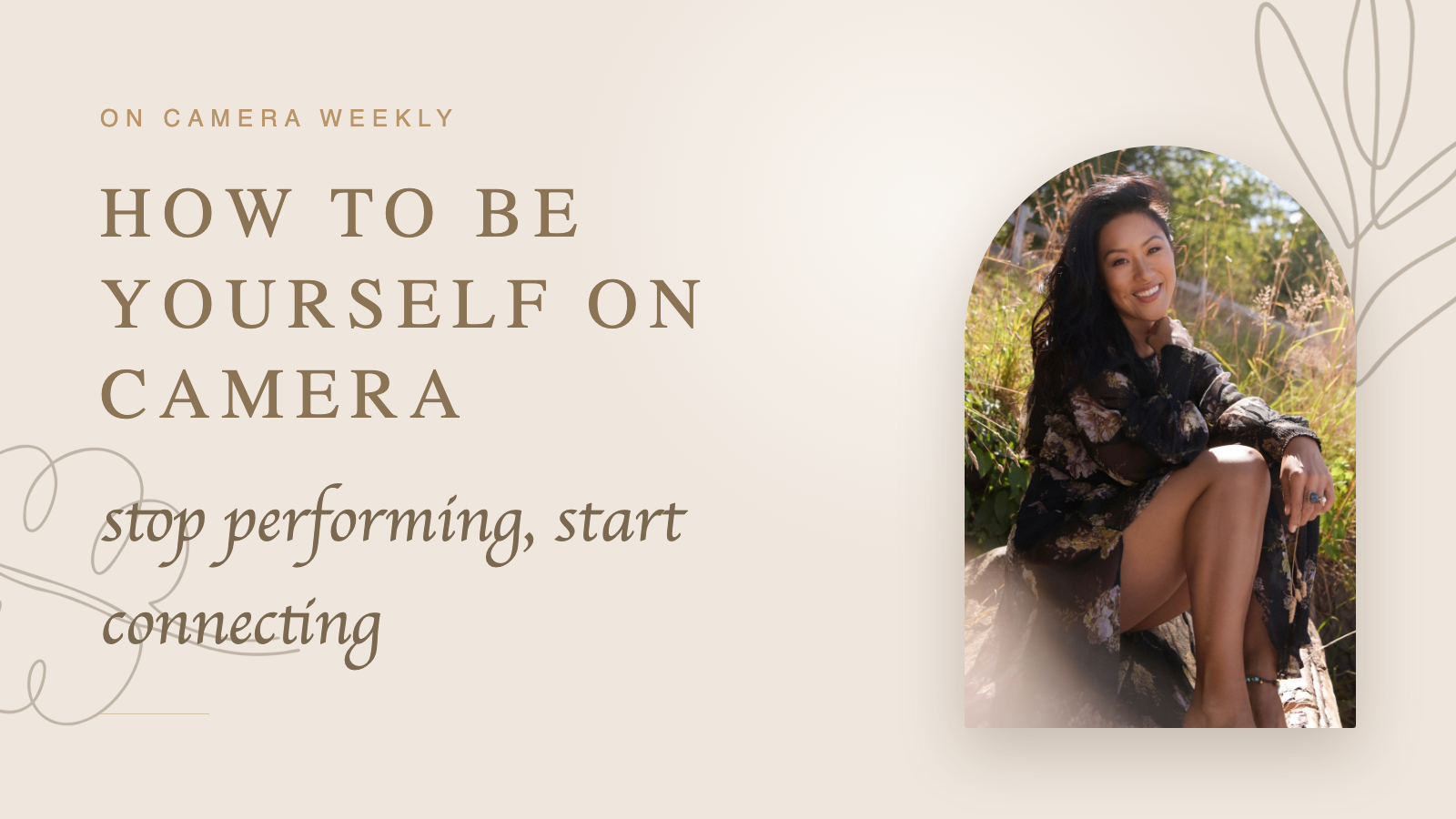
Twenty years on professional film sets. And the first time I turned a camera on myself, alone in my own home, I froze.
I want to start with a confession, because I think you'll recognize yourself in it.
I'm a professional actor and producer. I've spent over two decades in the entertainment industry — you might have seen me on The Good Doctor with Freddie Highmore, or in Skyscraper with Dwayne Johnson. I have stood on sets with a hundred crew members, cameras the size of small dogs pointed at my face, and delivered lines on cue.
And still. When it came time to sit in front of my own little camera and just… talk, as me? Everything locked up. I know what it's like to feel blocked by perfectionism, self-doubt, and fear of being seen. That used to be me — until I learned how to stop performing and start connecting. I realigned with my message, let go of the overthinking, and finally showed up as myself.
That last sentence took me years to live. This post is my attempt to hand it to you faster — because if you've been searching for how to be yourself on camera, I promise the answer is simpler than you fear. Not easier. Simpler.
Not sure what to film next? Creative Compass builds the plan with you.
Why "just be yourself" is useless advice
Let's deal with the obvious problem first. Everyone tells you to "just be yourself on camera," and it's about as helpful as telling a person who can't sleep to "just relax."
Here's why it fails: it treats being yourself as a personality trait — something you either have or you don't. It isn't. Off camera, you're yourself constantly, effortlessly, without a single thought. On a good phone call. Across a dinner table. Ranting to your best friend about a show. You don't try to be yourself in those moments. You're just… aimed at someone.
That's the secret hiding in plain sight. Being yourself is not a trait. It's a direction of attention.
When the camera turns on, your attention swings inward: How do I look? Was that word right? Is my energy okay? Who am I to talk about this? The moment your attention points at yourself, you start managing yourself — and managing yourself is performing. Not the good, crafted kind of performing actors train for. The exhausting kind. The kind viewers can smell through the screen.
When your attention points at another human being, the managing stops, because there's no attention left over to do it with. That's connection. And it is the entire game.
Performing vs. connecting: the only distinction that matters
Every piece of practical advice I'm about to give you comes down to this one line, so let me draw it clearly.
Performing is speaking at an audience while monitoring yourself. The signals: a voice slightly higher and more "presentational" than your real one. Energy that's pushed. Sentences that sound written. A smile that's held rather than happening. Underneath it all, one continuous question: am I doing this right?
Connecting is speaking to one person while caring about them. The signals: your actual voice, at its actual pitch. Pauses where thoughts actually happen. Sentences that wobble a little, like real speech. And underneath it, a completely different question: are you getting this? Does this help you?
Here's what took me twenty years to fully accept: the camera transmits the underneath question. Viewers can't articulate it, but they feel which question you're asking. Performance creates distance — it puts the viewer in an audience seat. Connection collapses distance — it puts them across the table from you. And people don't follow, buy from, or trust a performance. They trust a person who seems to be talking to them.
So we're not going to work on your confidence. We're going to work on your aim.
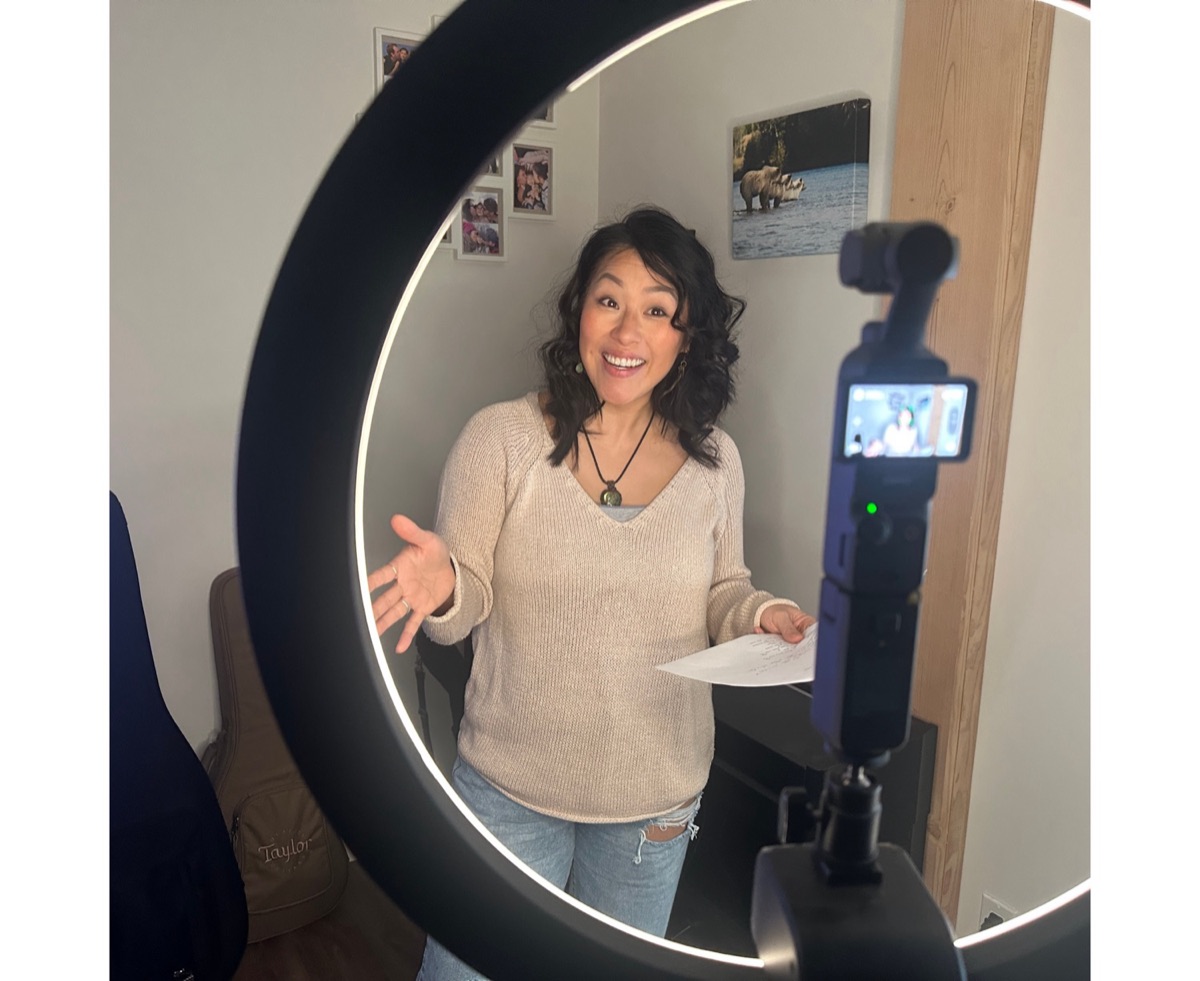
How to be yourself on camera: four practical shifts
These are the shifts I practise myself, in front of the same little camera that used to freeze me. They're not steps to complete once — they're aims to reset every single time you film.
1. Talk to one person you love
You freeze because you're talking to a lens instead of a person. So talk to one person you love. Watch what happens.
Before you press record, choose someone real and specific — your sister, your best friend, that one client whose face lights up when things click. Picture them just behind the lens, and say your first sentence directly to them. Not to "everyone watching." Not to the algorithm. To her.
Your whole system knows how to talk to someone you love. Your voice finds its natural register. Your face moves like a face. Warmth shows up without being summoned. And here's the beautiful math of it: the viewer on the other end doesn't feel like one of thousands. They feel spoken to — because you actually were speaking to someone.
2. Say it like you'd say it across a kitchen table
For every line you plan to say, there's a version of it you'd use at a kitchen table — shorter, plainer, warmer. That's the version that belongs on camera.
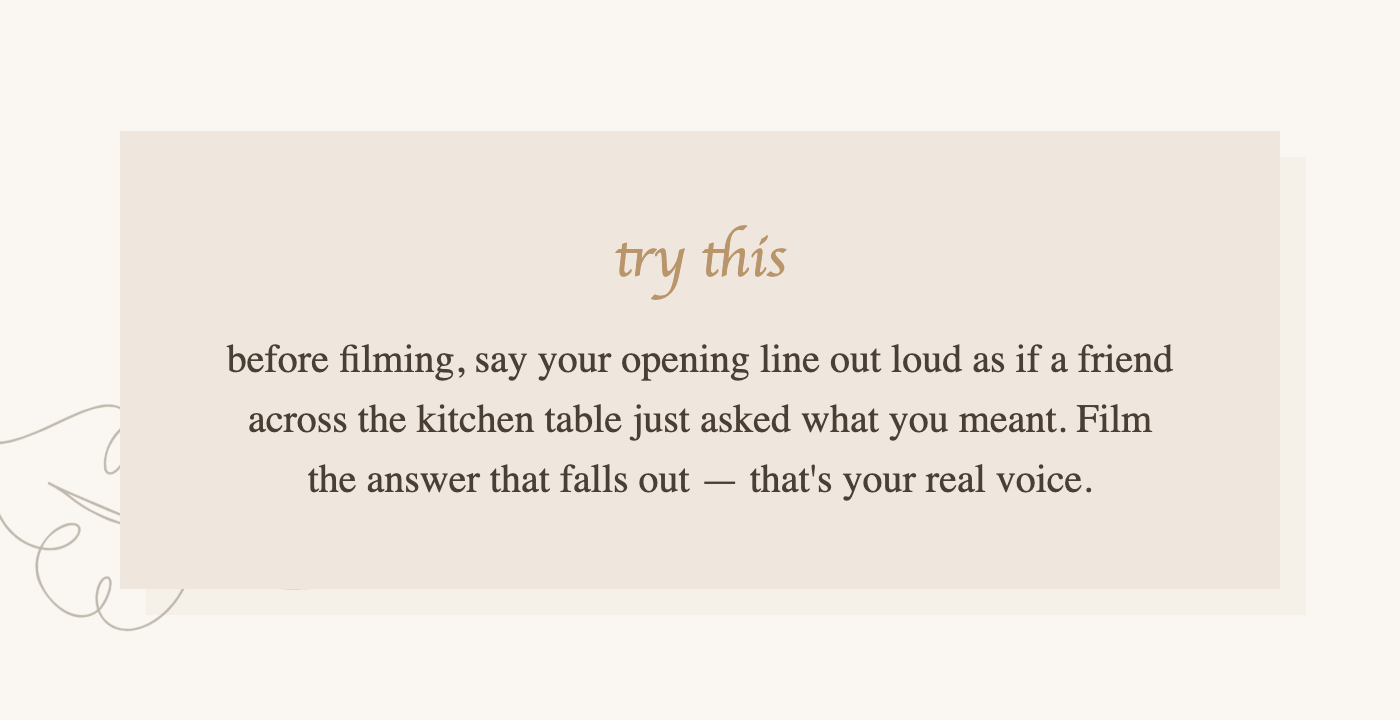
Try this test with your next video's opening line. Say the scripted version out loud. Then imagine your friend across the table asks, "wait, what do you mean?" — and answer her. That answer, the one that just fell out of your mouth? Film that. If a sentence is something you would never say to a person sitting three feet away, it doesn't belong in your video, no matter how polished it looks in the script.
3. Let the imperfect take live
This is the one that stings, and the one that matters most. When you stumble on a word, or laugh at yourself, or pause to find a thought — keep rolling. And then, at least sometimes, post that take.
I spent years as a perfectionist, so believe me, I know what your brain says: the stumble makes you look unprofessional. But watch how you respond to other people's videos. The tiny stumble, the self-aware laugh, the moment someone visibly searches for the right word — those are the moments you trust them more, not less. Perfection reads as performance. The human wobble reads as presence. Your twelfth take is usually more polished and less alive than your second, and viewers choose alive every time.
4. Drop the script-voice
You know script-voice. It happens the instant your eyes hit written words or your memory starts reciting: the pitch lifts, the rhythm flattens into evenness, and you start sounding like an announcement instead of a person.
The fix is not "don't prepare" — it's to prepare differently. Instead of scripting sentences, script beats: three to five bullet points of what you want this one person to walk away knowing. Then talk your way from beat to beat, in whatever words show up. The words will be rougher than a script. They will also be unmistakably yours — and that's the trade that wins.

What connection actually unlocks
I want to show you what's really at stake here, because it's bigger than better videos. A member, Iris, came to me feeling vulnerable and discouraged about being on camera. Here's what she wrote afterward:
"When I reached out to Elfina, I felt vulnerable and discouraged. Through her thoughtful questions, it felt as if she could already see the deeper truth behind what I was saying. She gently guided me to discover my own truth — not just about being in front of the camera, but about something much deeper: my sense of worth as a person."
— Iris vd Stelt
Read that again: not just about being in front of the camera. That's the pattern I see constantly. The camera isn't really the problem — it's a very honest mirror for the question underneath: do I believe I'm worth listening to? Every time you choose connection over performance, you're not just improving a video. You're practising the answer.
The myth: "being yourself" means winging it
Before you go film something, let's clear the misunderstanding that trips up almost everyone who embraces this idea.
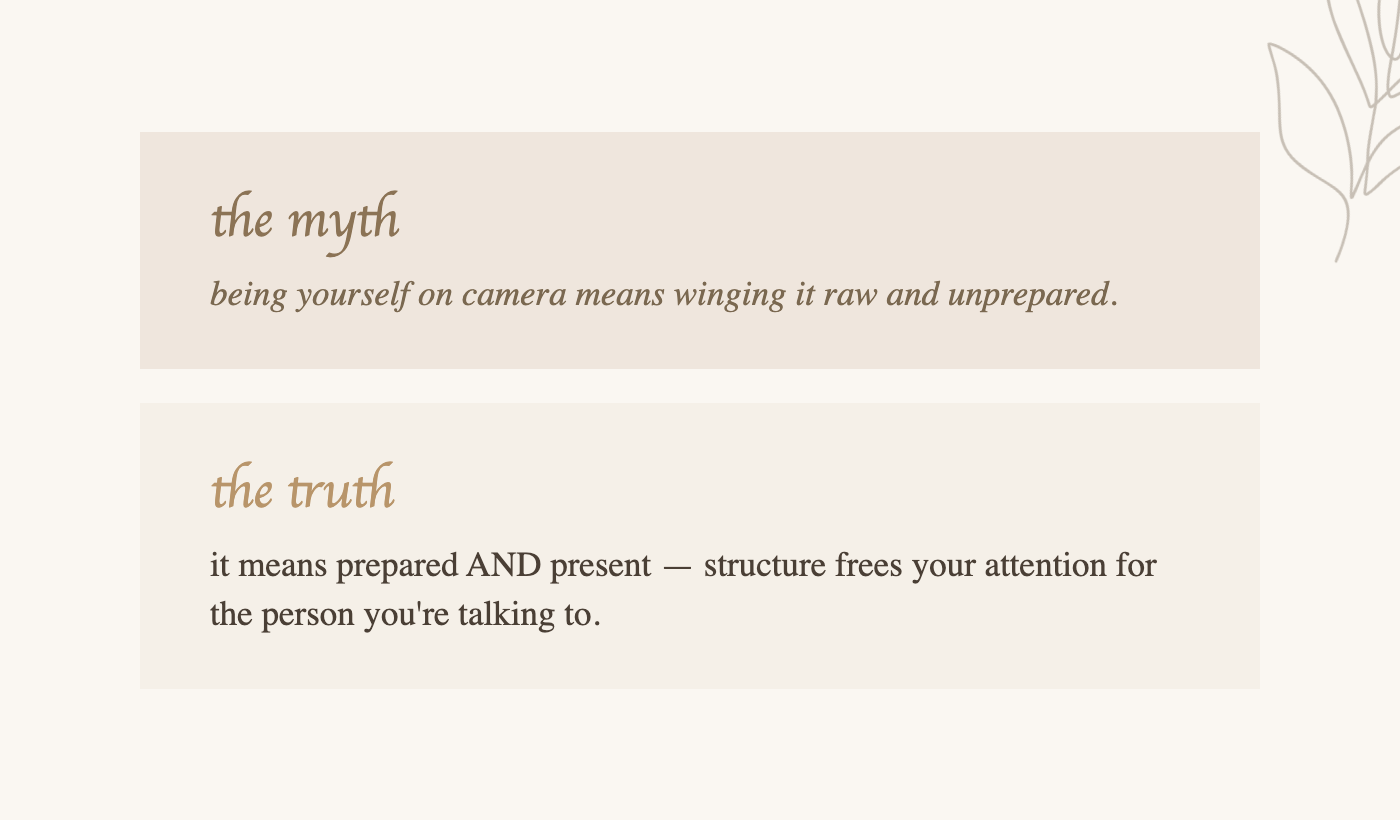
When people hear "stop performing," they sometimes swing to the other extreme: no preparation, no structure, just press record and pour it all out raw. Then the video rambles for eleven minutes, says four things at once, and they conclude that being themselves doesn't work.
Being yourself on camera doesn't mean being unprepared. It means being prepared and present. You still choose your message. You still know your beats, your opening line, roughly where you'll land. Preparation is what frees you to be present — when you know where you're going, your attention is available for the person you're talking to instead of scrambling for the next thought. Twenty years of acting taught me this: the most natural-looking moments on screen are usually the most prepared ones. The preparation just happened before the camera rolled, so the camera only sees the presence.
The version of you that's already ready
Here's what I believe, after two decades in front of cameras and years of helping others get there: you don't need to build a camera-ready self from scratch. She already exists. She shows up every time you talk to someone you love about something you care about. The work isn't construction. It's redirection — turning that existing, warm, articulate you toward a lens, one person at a time, one imperfect take at a time.
Start today, small. One video. One beloved person behind the lens. One kitchen-table sentence. And when you watch it back — gently, please; I wrote a whole guide on how to watch yourself on video without cringing — look for the seconds where you forgot the camera and just talked. That's her. That's you.
If you'd like to know exactly where you're starting from, take the Camera Confidence Zone quiz — a few minutes, and you'll see which zone you're in and what to practise next.
Be seen. Be heard. Be authentically you.
On camera and in life.
Being yourself gets easier when you're not also directing yourself. Compass takes the directing — what to shoot, how to frame it, where it's going — so you can just talk.
See How It Works