
Recorded video has a delete button. Live doesn't. That's the whole fear, right there.
I want to tell you about the longest thirty seconds of my on-camera life, and it wasn't on a film set. It was on my couch, thumb hovering over a button that said "Go Live," heart going like I'd just run up a hill.
Which made no sense. I'd spent twenty years acting on sets — I've worked opposite people you'd recognize, said lines with cameras three feet from my face. But a set has takes. A set has "let's go again." My whole career, there had always been a version of the delete button somewhere in the room.
Live has none. And my body knew it before my brain did.
If your thumb has ever hovered over that same button — or if you haven't even let yourself get that far — this post is for you. Here's what it will change: you'll see why the fear of going live is so much louder than the fear of recording, why the thing you're afraid of is actually the best-case scenario, and exactly how to get from "watching other people's lives" to "starting your own" in four gentle steps. No script. No pretending it's easy. Just a ramp instead of a cliff.
Not sure where you’re starting from? Find your Camera Confidence Zone — it takes two minutes.
Why the fear of going live is louder than the fear of recording
Let's name it precisely, because naming it takes some of its power away.
When you record a video, there's a safety net between you and being seen. You can watch it back. Re-do it. Fix the weird pause, trim the beginning, decide at the very last second not to post at all. Every one of those options is a little parachute, and your nervous system counts them all before you press record.
Going live removes every parachute at once. Whatever happens — the stumble, the blank, the dog barking, the phrase that comes out backwards — happens in front of people, in real time, with no take two. The fear of going live isn't really about technology or talent. It's the fear of being seen with the safety net gone.
Which is why "just practice more" doesn't fix it. You're not under-rehearsed. You're un-parachuted. Different problem, different solution.
The most forgiving audience you'll ever have
Now here's the reframe, and I need you to actually sit with it rather than skim past, because it's the honest truth and it changes everything.
A live audience is the most forgiving audience you will ever have. More forgiving than the people who watch your polished, edited videos.
Think about who's actually there. Nobody lands in your live by accident. They saw your name, and they tapped it. They chose you, in real time, over everything else on their phone. That's not an audience waiting for you to fail — that's a small room of people quietly rooting for you.
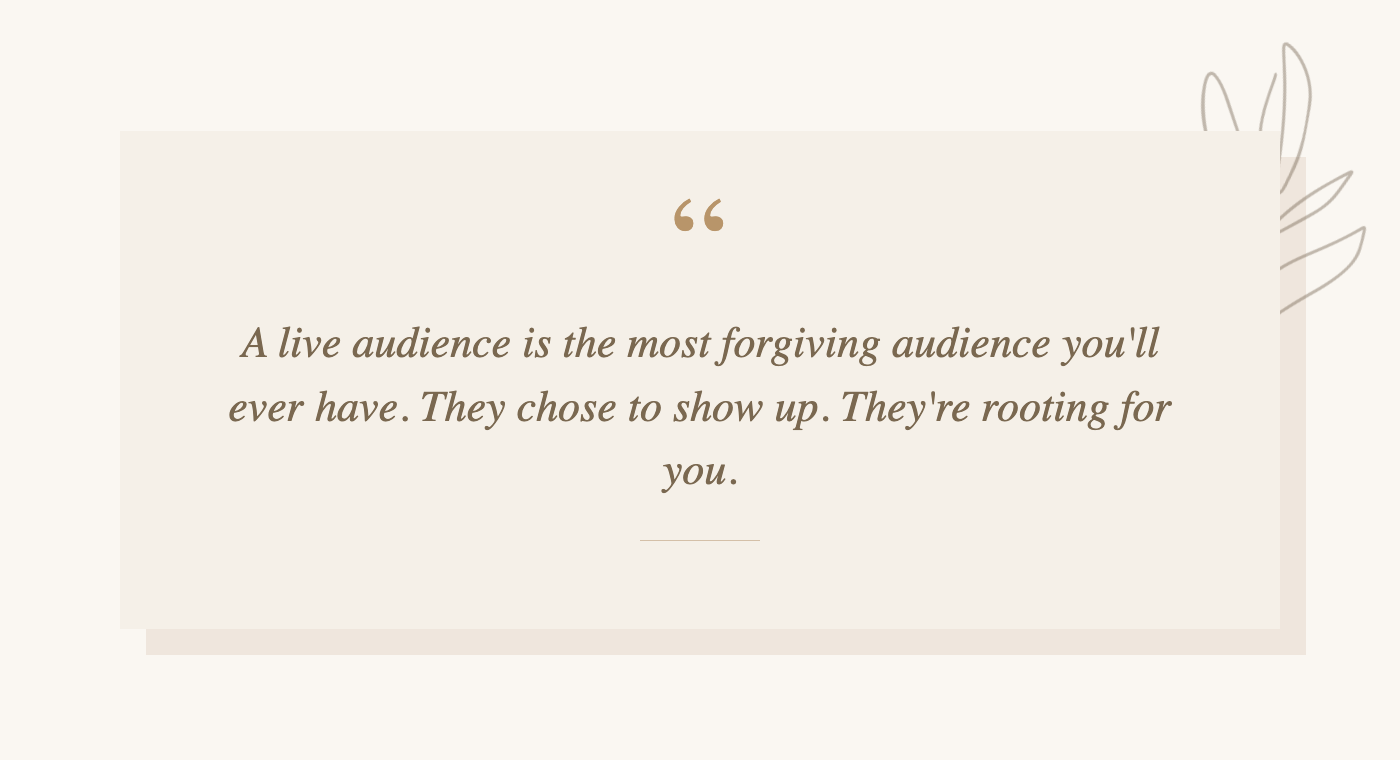
And the imperfections you're dreading? They work for you on live. When your video freezes for a second, when you lose your place, when your kid walks in — nobody watching thinks less of you. They think, oh, she's real. The glitches are proof there's no trickery, no editing, no performance. That's the entire appeal of live. People don't tune in for polish; they have Netflix for polish. They tune in for a human, as-is, right now.
Perfection on a live would almost be a disappointment.

The on-ramp: four rungs from watching to going live
You don't overcome the fear of going live by white-knuckling one big scary broadcast. You climb a ladder where each rung is only slightly braver than the last. Here's the one I recommend.
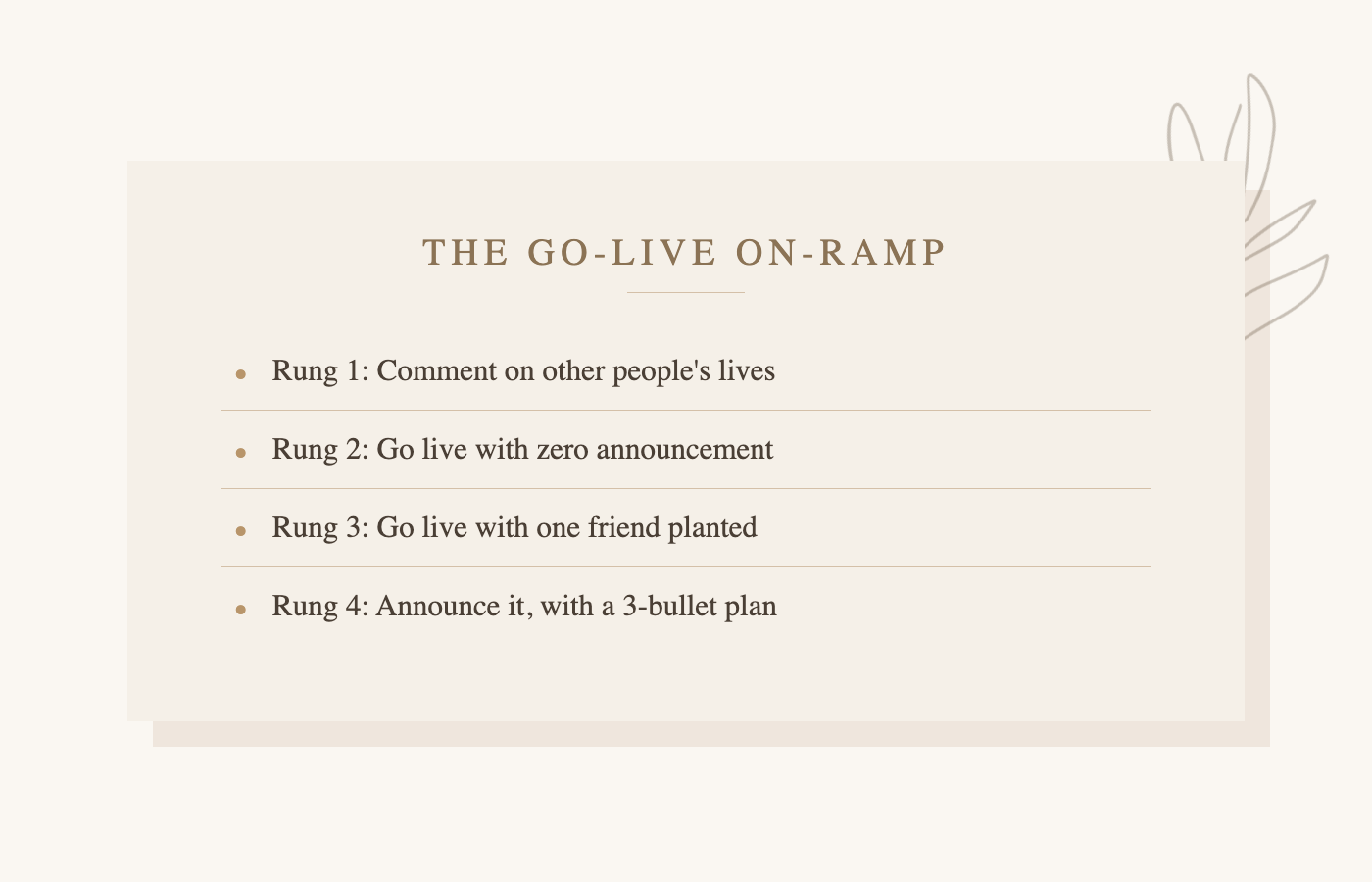
Rung 1: Comment on other people's lives
Start on the safe side of the camera. Join other people's lives and say something in the comments — a hello, a question, an encouragement. Two things happen. You learn the rhythm of live from the inside: how hosts handle comments, what they do when they lose their place, how unpolished it all actually is. And you feel, firsthand, how it feels to be a viewer. Notice that you're not judging the host. You're rooting for them. That's exactly who'll be watching you.
Rung 2: Go live to no one — on purpose
This is the rung people skip, and it's the most important one. Go live with zero announcement. Don't post about it, don't tell a soul, pick a sleepy time of day. Talk for three or four minutes about anything, to nobody.
If no one shows up — and at first, likely no one will — that is not a failed live. That's a flight simulator. You just did the entire scary thing, pressed the actual button, spoke into the actual void, with none of the stakes. Nobody coming is a feature, not a bug. Do this rung two or three times and something shifts: the button stops being a cliff edge and starts being a light switch.
Rung 3: Go live with one friend planted
Now add one face. Text a friend: "I'm going live at 7 for ten minutes — will you hop on and just be there?" Then, when you're live, talk to her. Answer her comment. Say her name. You're not broadcasting to the internet anymore; you're having a conversation that other people are welcome to join. That one shift — one real person to talk to — is the difference between speaking into a void and speaking across a table.
Rung 4: Announce it — with a three-bullet plan, never a script
Now you're ready for a real, announced live. Tell people when you're coming on and what it's about. And prepare exactly this much: three bullet points on a sticky note.
Not a script. Never a script. A script on live is a trap — the moment real life interrupts (and on live, it always does), you have to find your place again in a wall of text while people watch. Three bullets can flex around anything. A script can only break.
Your first ninety seconds, planned
The scariest stretch of any live is the beginning, so let's take the guesswork out of it. Three moves:
- Greet like a host, not a broadcaster. "Hi — I'm so glad you're here." Warm, simple, done. Say hello to names as they pop in.
- Say what you're here to share. One sentence. "I want to talk about the thing that finally got me posting every week." Now everyone — including you — knows what this is.
- Start before it feels ready. Do not wait for more people. "We'll just give it another minute while people join" is where lives go to die — it's dead air for the people already there, and it teaches your nerves that we stall when we're scared. Begin for the two people present. The replay viewers will thank you too.
Ninety seconds in, you're no longer starting a live. You're just talking. The hard part is behind you.
When your mind goes blank — live
It will happen. Mid-sentence, the thought just… leaves. Here's what to do, and it's almost embarrassingly simple:
Say so. Out loud. With a smile.
"Okay, I just completely lost my thought." Then breathe, glance at your three bullets, and carry on.
Here's why this works. What you fear in that moment is that the blank reveals you as a fraud. What the audience actually experiences is a person being honest in real time — which is the very thing they came for. "I just lost my thought" is not a failure on live. It's connection. Every single person watching has lost a thought mid-sentence. You just became more relatable, not less credible. The panic only wins if you pretend it isn't happening.
Proof: what happens on the other side of the fear
I've watched this ladder work for people who were sure it wouldn't work for them. A member put it this way after a video training together:
"Today's video training was amazing!! Thank you Elfina!!!! I haven't recorded a video in I can't remember when! Not only did I record 5 videos but I tapped back into WHY I want to record videos!! Five stars all the way!"
— A.N.
I love that word — why. That's what fear costs you, mostly. Not opportunities, not followers. It disconnects you from the reason you wanted to speak in the first place. And when the fear shrinks — rung by rung, not in one heroic leap — the why comes flooding back. Five videos in a day, from someone who couldn't remember her last one.
The myth: "going live requires being quick-witted"
This is the belief that keeps most people on the ground floor of the ladder: live is for naturally quick, funny, articulate people — and I'm not one of them.
Here's the truth. Going live doesn't require being quick. It requires being present. Those are different skills, and the second one is learnable by everyone.
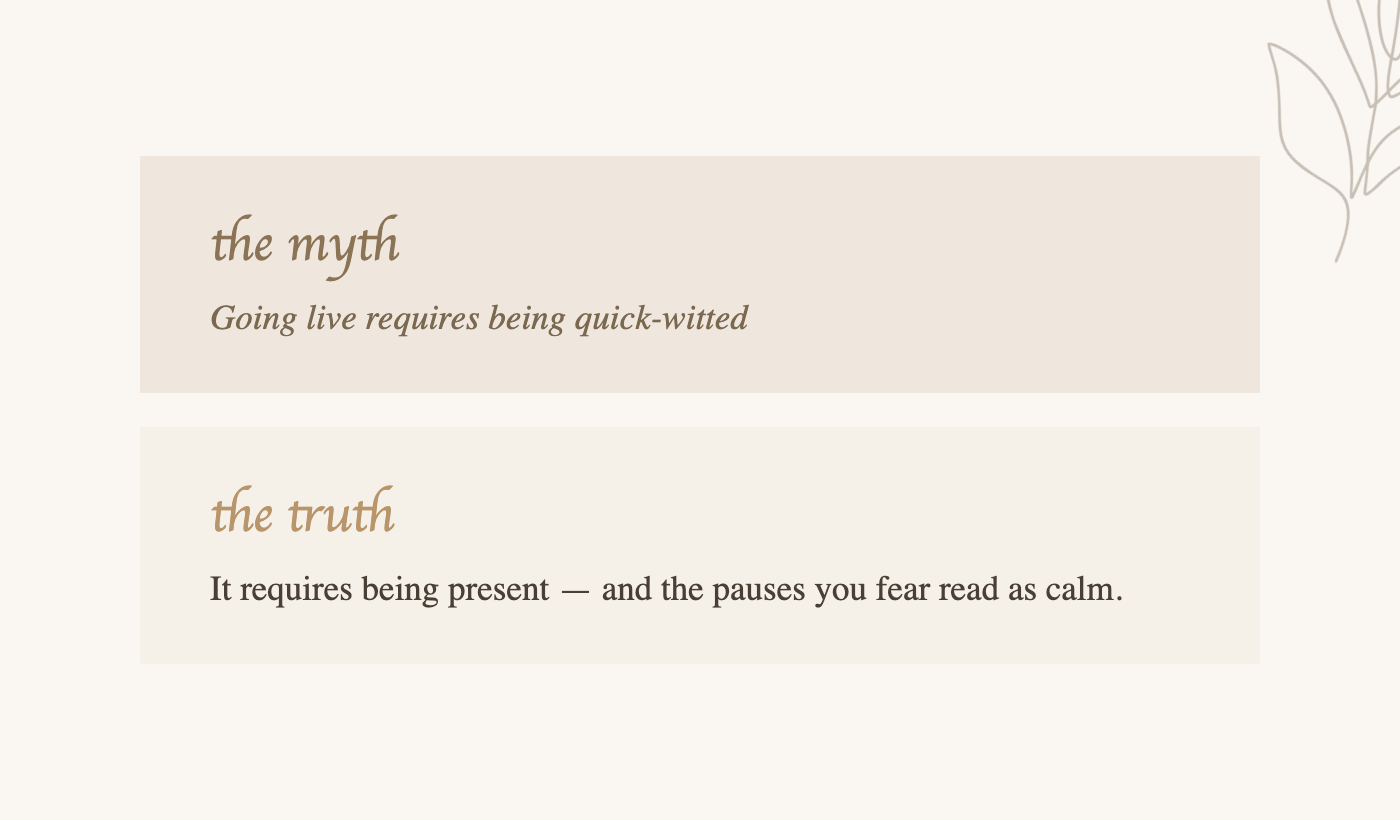
Quick-witted is about filling every silence. Present is about being okay inside the silence. And here's the part nobody tells you: the pauses you're terrified of don't read as awkward to the viewer. They read as calm. When you stop to think on a live, the audience doesn't see someone struggling — they see someone considering, someone unhurried, someone at home. The most magnetic people on live aren't the fastest talkers. They're the ones who seem like they're in no rush at all.
You already know how to be present. You do it in every good conversation you've ever had. Live just asks you to do it with the camera on — and if the camera itself is still the sticking point, start with overcoming camera shyness first, then come back to the ladder. The rungs will still be here.
Press the button scared
Here's the quiet truth under all of this: the fear of going live never fully asks your permission to leave. You don't wait for it to be gone and then go live. You go live a little scared, to nobody, on purpose — and the fear, having nothing to feed on, gets smaller. Then a little smaller. Then one day you notice you're just… talking to people you like, live, and it's Tuesday.
Start on rung one this week. Just comments. That's it.
And if you'd like to know exactly where your camera nerves are coming from before you climb, take the Camera Confidence Zone quiz — two minutes, and it'll show you which rung is actually yours. Then come climb with people who get it. There's a whole community of us practicing being seen, gently, together.
Be seen. Be heard. Be you — live, and in no rush at all.
Two minutes, a handful of honest questions, and you'll know exactly which zone you're in — and what to work on next.
Take the QuizGoing live feels steadier when the plan exists before you press the button. Compass gives you the structure to hold onto while you're in it.
See How It Works