
You said it perfectly in the shower this morning. Then you tapped record, and someone else showed up.
You know the scene. Phone propped against a stack of books. Good light, for once. You know exactly what you want to say — you've said it out loud twice today already, easily, warmly, to no one.
Then the red dot appears. And your voice goes strange. Your smile turns into something you're doing with your face instead of something you're feeling. Four seconds in, you stop the take.
"I'm just camera shy," you tell yourself. And you say it like a diagnosis. Like a wall.
I want to gently take that wall apart, because I've stood exactly where you're standing. Twenty years on film sets, and the first time I turned a camera on myself — no director, no character to hide inside — I felt sick. Me. The person who does this for a living.
So here's the reframe this post is built on: being camera shy is not a flaw, and it's not a missing skill. It's a protection response. A very old, very loyal part of you is trying to keep you safe from being seen and judged. Once you understand that, everything changes — because you stop trying to defeat yourself and start working with yourself. In the rest of this post: why it happens, why the most common advice fails, and the gentle sequence that actually works.
Not sure where you’re starting from? Find your Camera Confidence Zone — it takes two minutes.
What camera shyness actually is
Here's the strange thing about a lens. It's a small dark circle, smaller than a coin. And yet when it points at you, your body reacts like you just walked onto a stage.
That's because the lens isn't one person. To your nervous system, it's an audience of everyone. Every future viewer. Every stranger who might scroll past. Every critical voice you've ever internalized — the teacher, the ex, the comment section you read once and never forgot. All of them, compressed into that little circle, watching you at once.
Being seen and judged by a group used to be genuinely dangerous for humans. Your body remembers. So it does what protection systems do: it tightens your voice, blanks your mind, and floods you with the urge to stop. The freeze isn't weakness. It's machinery. Very good machinery, pointed at the wrong threat.
And notice what that means: nothing about the freeze says you're bad at video. It says your body hasn't yet learned that this particular kind of being seen is safe.
Why "just practice more" fails when you're camera shy
If you've ever confessed that you're camera shy, someone has told you to practice more. Record every day! Do it scared! Reps, reps, reps!
Here's why that advice keeps not working, and why it was never your fault.
Practice fixes skill problems. If your framing is off or your rambling runs long, repetition genuinely helps. But camera shyness isn't a skill problem — it's a worth problem. The fear underneath isn't "what if I do this badly?" It's "what if they see me and decide I'm not enough?" No number of reps answers that question, because it was never a question about technique.
Worse: practicing while your whole body is braced for judgment doesn't teach you ease. It teaches you to associate the camera with bracing. You're not rehearsing the video. You're rehearsing the fear — deepening the exact groove you're trying to climb out of.
So no, you don't need more willpower or a thirty-day posting streak. You need to change what the reps mean before you add more of them. That's the whole secret, and here's how it works.
What actually works: four gentle moves, in order
This sequence matters. Each step lowers the perceived danger a little more, so your protection system can finally stand down. Don't skip ahead — the early steps are the ones doing the deep work.
1. Shrink the audience to one
You freeze because you're talking to a lens instead of a person. So talk to one person you love. Watch what happens.
Before you record, picture one specific person — your best friend, your sister, the client you adore — and speak the entire video to them. Not "everyone watching." Not "my audience." One warm face who already likes you. Your voice will change within a sentence, because you already know how to talk to someone you love. You've been doing it your whole life. This move doesn't add a skill; it removes the crowd.
2. Give yourself permission to start imperfectly
This is the step almost everyone refuses, and it's the one that changes the most: record videos with zero intention of posting them. Ever. Private-first reps.
When a video can never be seen, it can never be judged — and your protection system knows it. So the freeze has nothing to protect you from. These private reps are where your body quietly learns, over and over: camera on, and nothing bad happened. That lesson can't be learned while stakes are high. It has to be learned in safety first.
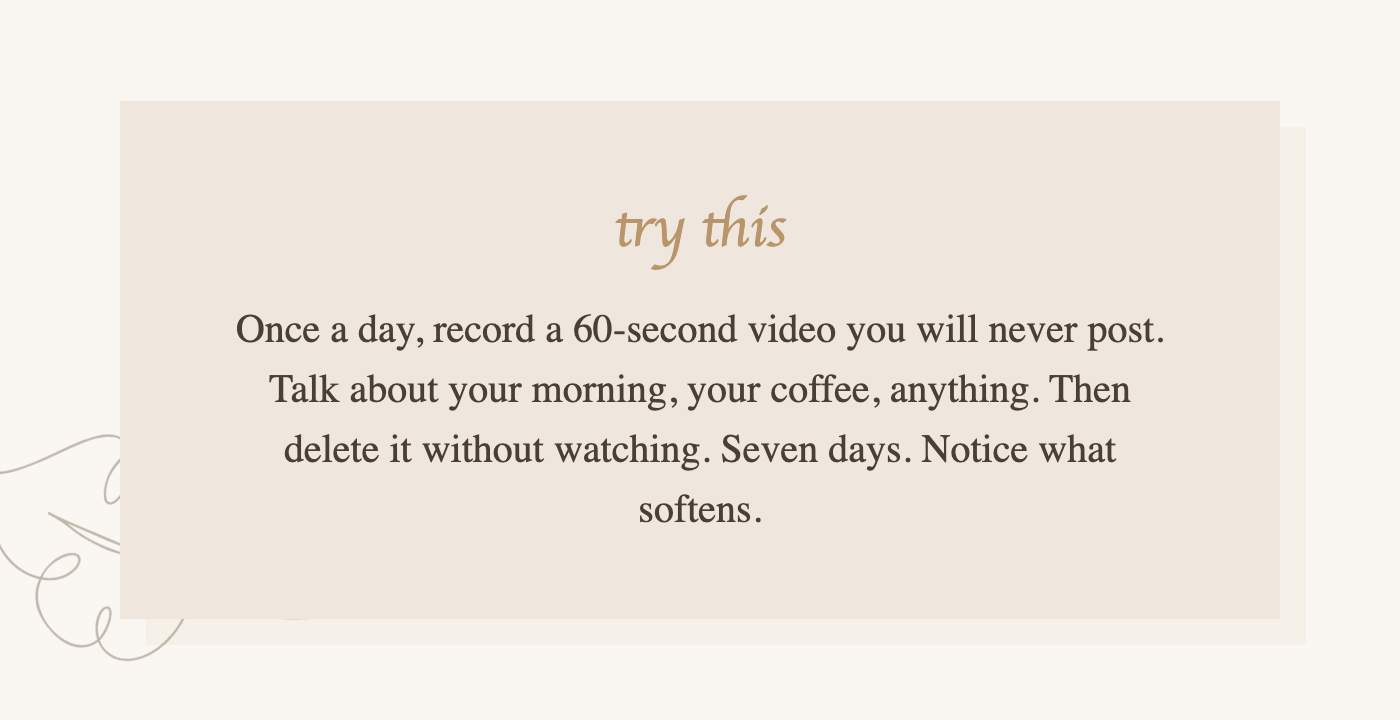
And yes — imperfectly means imperfectly. Messy hair. Lost trains of thought. Restarts mid-sentence that you don't fix. The goal of these reps isn't good video. The goal is a nervous system that stops sounding the alarm.
3. Lower the stakes on purpose
Most camera shy people accidentally do the opposite: they decide their first real video has to be important. A polished introduction. A big value-packed tutorial. They stack the stakes sky-high and then wonder why their body refuses.
Flip it. Deliberately make your early videos small: a fifteen-second story that disappears in a day. A casual video message to one friend instead of a post. A one-take rule — whatever happens in take one is what it is, and you're done. Every stake you remove is fear you don't have to carry. (If watching yourself back is its own special misery, you're not alone — I wrote about that in why you hate the sound of your own voice, because that discomfort has its own explanation and its own fix.)
4. Graduate the exposure, one rung at a time
Once private recording feels boring — and it will, sooner than you think — you climb. Slowly. One rung at a time:
- Record privately, delete without watching.
- Record privately, watch it back once, kindly.
- Send a video to one person you trust.
- Share one in a small, warm group.
- Post one publicly — small, low-stakes, one take.
Each rung only after the one below it feels easy. This is how fear actually dissolves: not in one brave leap, but in steps so small your protection system never needs to fire.
If you recognize yourself in the early rungs, you're in what I call the Starting Zone — the camera still feels unfamiliar, and fear of judgment is the biggest barrier. If you're recording but struggling to post consistently, that's the Building Zone. Different places on the same path, needing different things — I walk through all five in the 5 Camera Confidence Zones, and the Camera Confidence Zone quiz will tell you exactly where you're standing in about two minutes.
What this looks like when it works
I want you to hear how deep this really goes — because it was never about the camera. A member put it this way:
"When I reached out to Elfina, I felt vulnerable and discouraged. Through her thoughtful questions, it felt as if she could already see the deeper truth behind what I was saying. She gently guided me to discover my own truth — not just about being in front of the camera, but about something much deeper: my sense of worth as a person."
— Iris vd Stelt
"Not just about being in front of the camera." That's the whole thing, isn't it? The camera was never the real subject. Worth was. And when the worth question softens, the camera question gets so much smaller.
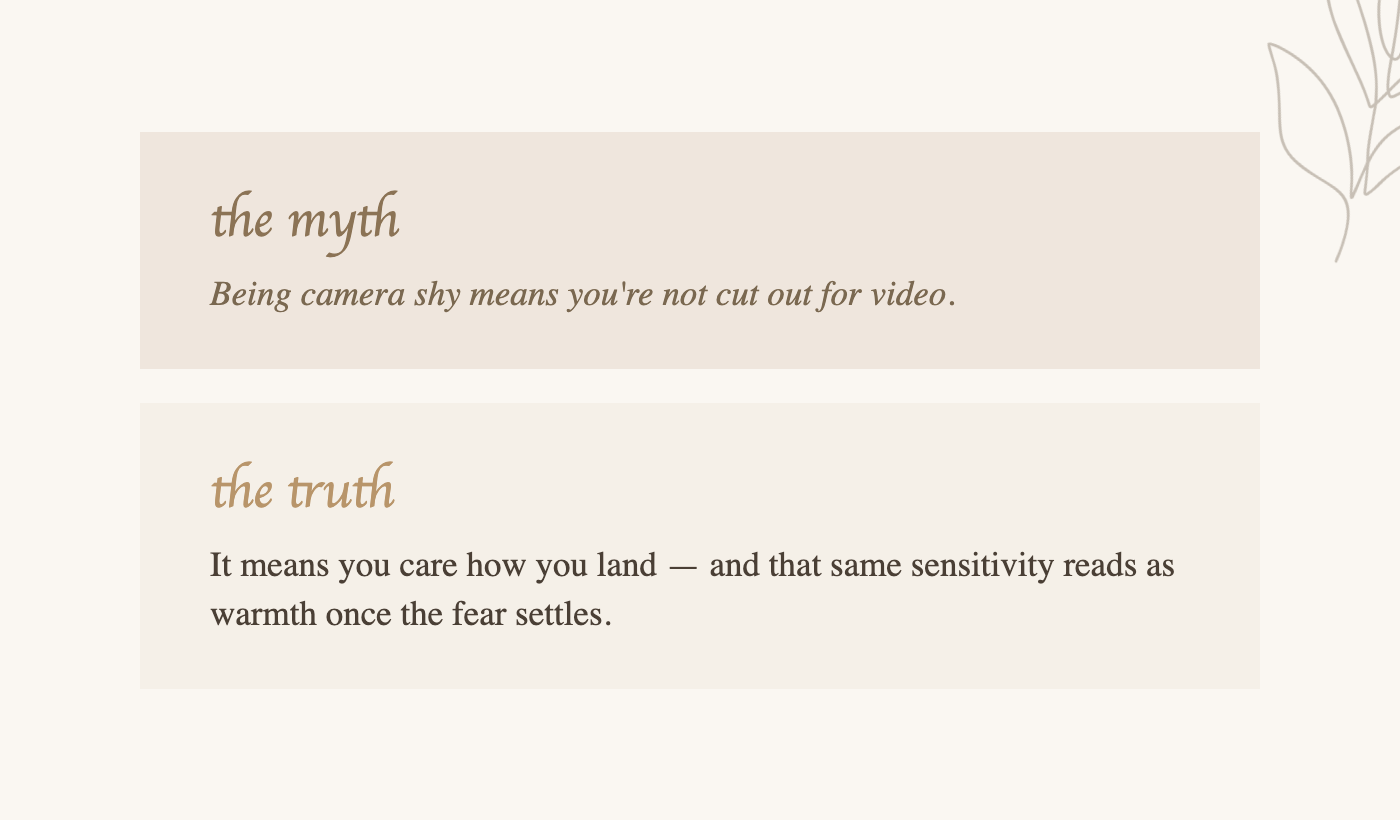
The myth: "camera shyness means you're not cut out for video"
Let's retire this one for good.
Camera shyness doesn't mean you lack whatever the confident people have. It means you care how you land. You're sensitive to how you come across, to whether you're connecting, to how your words feel on the other side of the screen. That sensitivity is the very thing that makes someone wonderful to watch — it just currently has fear wrapped around it.
And here's what I've seen again and again: when the fear settles, the sensitivity stays. It reads as warmth. As presence. As that quality where someone on a screen feels like they're actually talking to you. The people who were once the most camera shy so often become the most genuinely connecting on camera — not despite the sensitivity, but because of it.
So no, you're not disqualified. You might be carrying the exact raw material this work turns golden.
Start smaller than feels impressive. Talk to one person you love. Record something no one will ever see, today, and let it be gloriously imperfect. The wall you named "camera shy" was never a wall. It was a door that opens slowly — and you just put your hand on it.
Be seen. Be heard. Be authentically you.
Two minutes, a handful of honest questions, and you'll know exactly which zone you're in — and what to work on next.
Take the QuizShyness softens with repetition, and repetition gets easier when you're not inventing the plan each time. Compass hands you the next thing to film, so showing up is the only decision left.
See How It Works