
You knew every word. Then the red light came on, and every word left.
You've felt it, haven't you. You're mid-sentence, doing fine — and then something in you goes still. Your mind turns white. Your mouth keeps moving for a second like it's hoping the rest of you will catch up, and then it stops too. You stare at the lens. The lens stares back.
And afterwards comes the question you've probably typed into a search bar at eleven at night: why do I freeze on camera? I talk to the barista. I present in meetings. I explain this exact topic to friends without a single stumble. So why does a phone on a tripod turn me into a statue?
I want you to hear this first, before anything else: nothing is wrong with you.
The freeze is not a personality flaw, not a lack of preparation, and not proof that video "isn't for you." It's a threat response — one of the oldest pieces of machinery you own, doing exactly what it was built to do, just in the wrong situation. And once you understand what's actually happening in your body, the fix stops being a mystery. There are three steps. They're gentle. And they work in order.
Not sure where you’re starting from? Find your Camera Confidence Zone — it takes two minutes.
Why do I freeze on camera? Because your body thinks it's danger
Here's the strange truth about a lens. It's a tiny dark circle — smaller than a coin. But your nervous system doesn't see a circle. It sees an audience of everyone.
Every person who might ever watch. Every stranger scrolling past. Every critical voice you've collected over a lifetime — the teacher who read your work out loud, the relative with opinions, the one comment you saw on someone else's video and never forgot. All of them, compressed into that little black dot, watching you at once.
For most of human history, being watched and judged by the whole group was genuinely dangerous. Getting it wrong in front of everyone could cost you your place. Your body still remembers that math. So when the lens points at you, an ancient alarm goes off: you are exposed. And one of the body's oldest answers to exposure is to go still. Freeze. Don't move, don't speak, don't give them anything to judge.
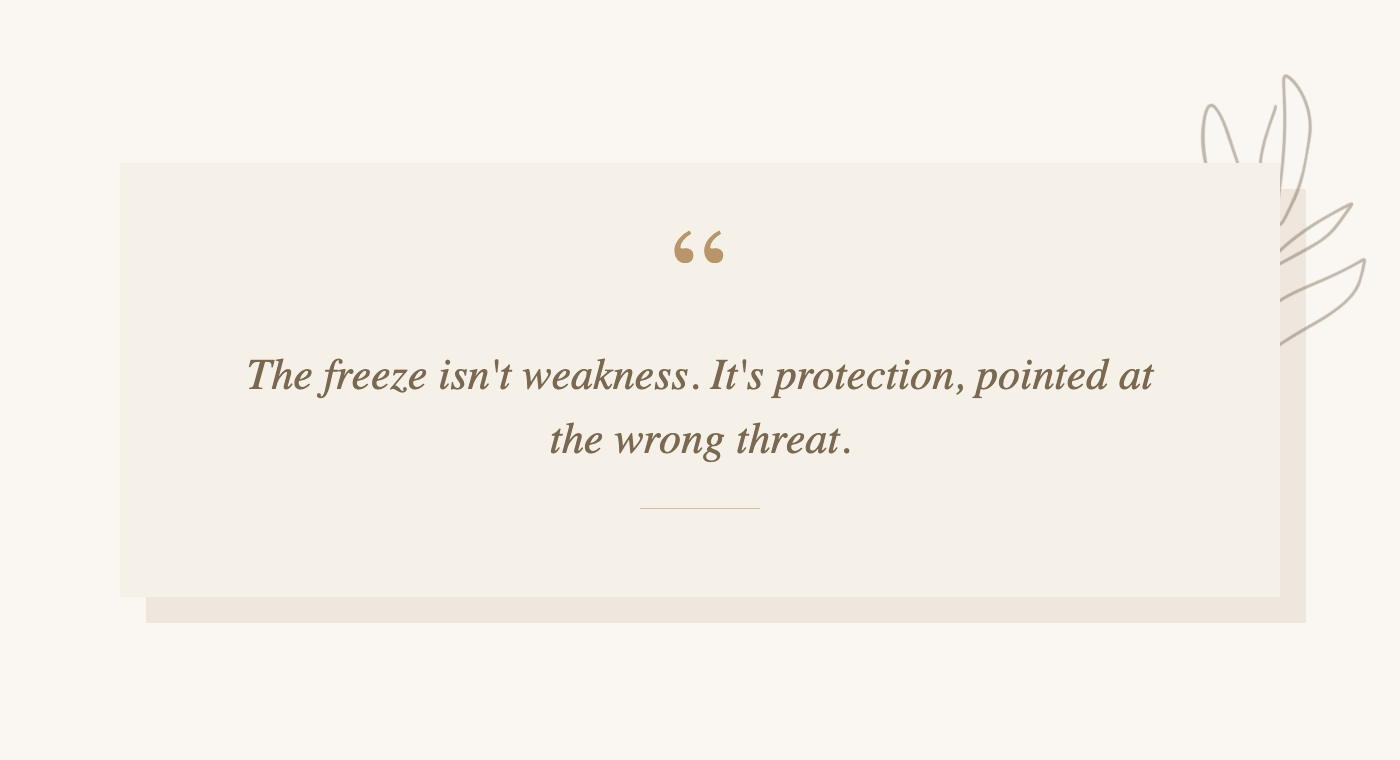
That's the freeze. Not weakness. Not stage fright you should have outgrown. Protection — loyal, fast, and pointed at the wrong threat.
Why knowing your content doesn't save you
This is the part that makes people feel truly stuck: you prepared. You knew your points cold. Some of you had a script two feet from the lens. And you froze anyway.
So you conclude you didn't prepare enough, and next time you over-prepare — more bullet points, more rehearsal, a full word-for-word script. And you freeze again, except now you're also frantically trying to remember exact sentences, which makes it worse.
Here's why. Preparation lives in your thinking brain. The freeze doesn't. Fear lives in the body, not the script. When the alarm fires, your body pulls resources away from the thinking brain — that's literally what a threat response does — and the very place your preparation is stored goes dim. It's like studying all night for an exam and then having someone pull the fire alarm as you pick up your pen. The knowledge is in there. The alarm is just louder.
Which means the fix was never more content. You can't out-prepare a fire alarm. You have to teach the alarm it doesn't need to ring.

The 3-step fix
These three steps work because each one lowers the danger signal your body is reacting to. Do them in order — the sequence is the point.
Step 1: Shrink the audience to one
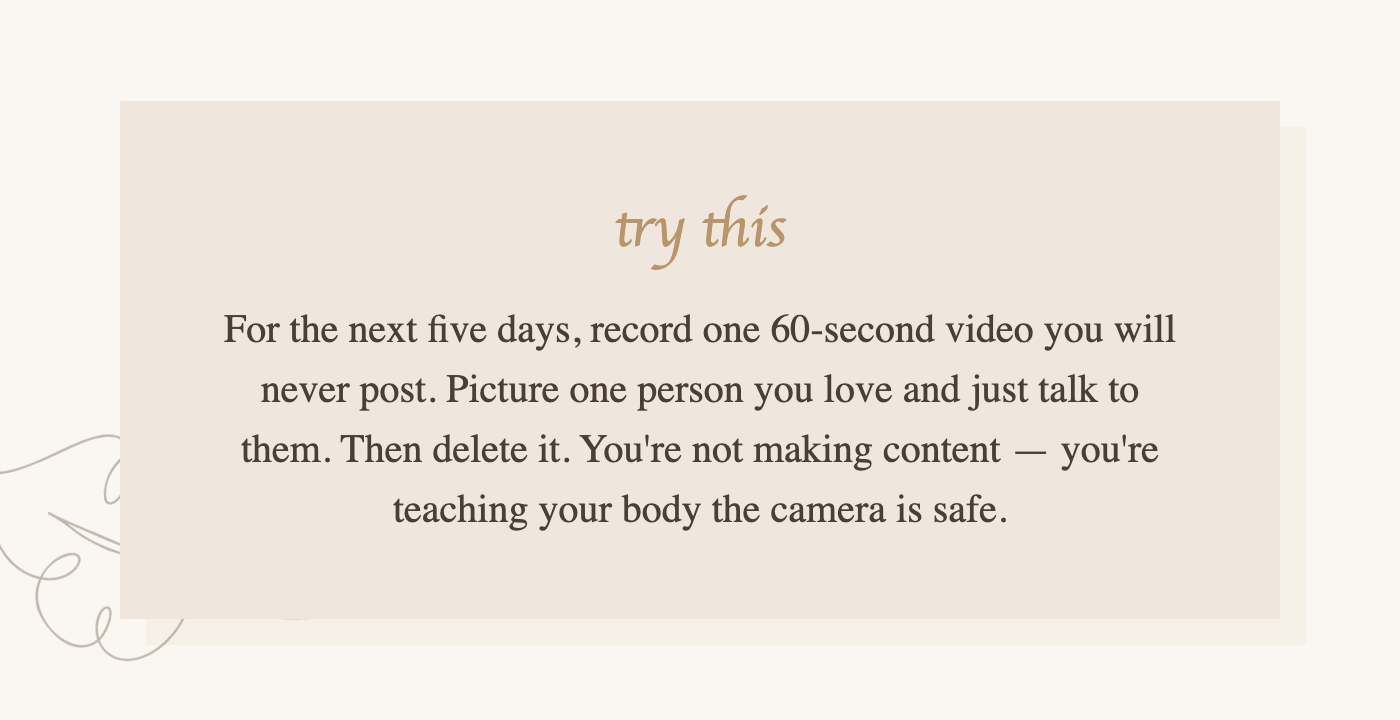
You freeze because you're talking to a lens instead of a person. So talk to one person you love. Watch what happens.
Before you press record, picture one specific face — your best friend, your sister, that client you adore helping. Then speak the entire video to them. Not to "everyone watching." Not to "my audience." To one warm person who already likes you and wants to hear this.
Your body can't panic about an audience of everyone while you're genuinely talking to an audience of one. And you already know how to talk to one person you love — you've done it your whole life, easily, warmly, without a script. This step doesn't ask you to learn anything new. It just removes the crowd.
Step 2: Drop the stakes to zero
Now take away the other half of the threat: the judgment. For a while, record videos with zero intention of posting them. Not "I'll post it if it's good." Never posting. Private, delete-when-done, no-one-will-ever-see-this recordings.
When a video can't be seen, it can't be judged — and your protection system knows that. So the alarm has nothing to ring about. And every single time you record in that safety, your body logs a quiet little lesson: camera on… and nothing bad happened. Again. And again. That's how the alarm gets recalibrated — not by arguing with it, but by showing it, in the body's own language, that this is safe. It has to be learned in low stakes before it holds up in high ones.
Step 3: Start talking before you feel ready
Here's the sneaky thing about the freeze: it lives in the pause. That gap between pressing record and saying your first word? That's where it moves in. The longer you sit there waiting to feel ready — clearing your throat, resetting your shoulders, taking one more breath — the more room the alarm has to build.
So don't wait. Press record and start talking immediately, even if your first sentence is "Okay, hi, I'm just going to start." Motion dissolves the freeze. A body that's already moving and speaking is very hard to lock up — the momentum itself tells your nervous system the danger has passed. Readiness isn't the entry requirement. It's the reward. It shows up a few sentences in, once you're already going.
And if your first sentence is a mess? Keep rolling. Say it again. The take doesn't need to be clean. It needs to be moving.
Where you are on the path
If the freeze is the main thing standing between you and video right now — if the camera still feels unfamiliar and the fear of being judged is the loudest voice in the room — you're in what I call the Starting Zone. There's nothing wrong with being there. It's a place on a path, not a verdict, and the three steps above are exactly what that zone needs. I walk through all five zones in the 5 Camera Confidence Zones, and if you want to know precisely where you're standing, the Camera Confidence Zone quiz takes about two minutes and tells you what to work on first.
I also want you to know this work goes deeper than technique, because the freeze usually has roots. A member put it this way:
"In those two hours with Elfina, something shifted. I started becoming conscious again. I began to feel joy and even discovered a safe space within myself. Now, whenever life feels dark and cold, I know exactly where to go. From the bottom of my heart, I highly recommend that you find yourself again."
— Nguyen D.
"The source of the trigger." That's the real work. The freeze is never random — it's protecting you from something specific, and when you find out what, it loosens its grip.
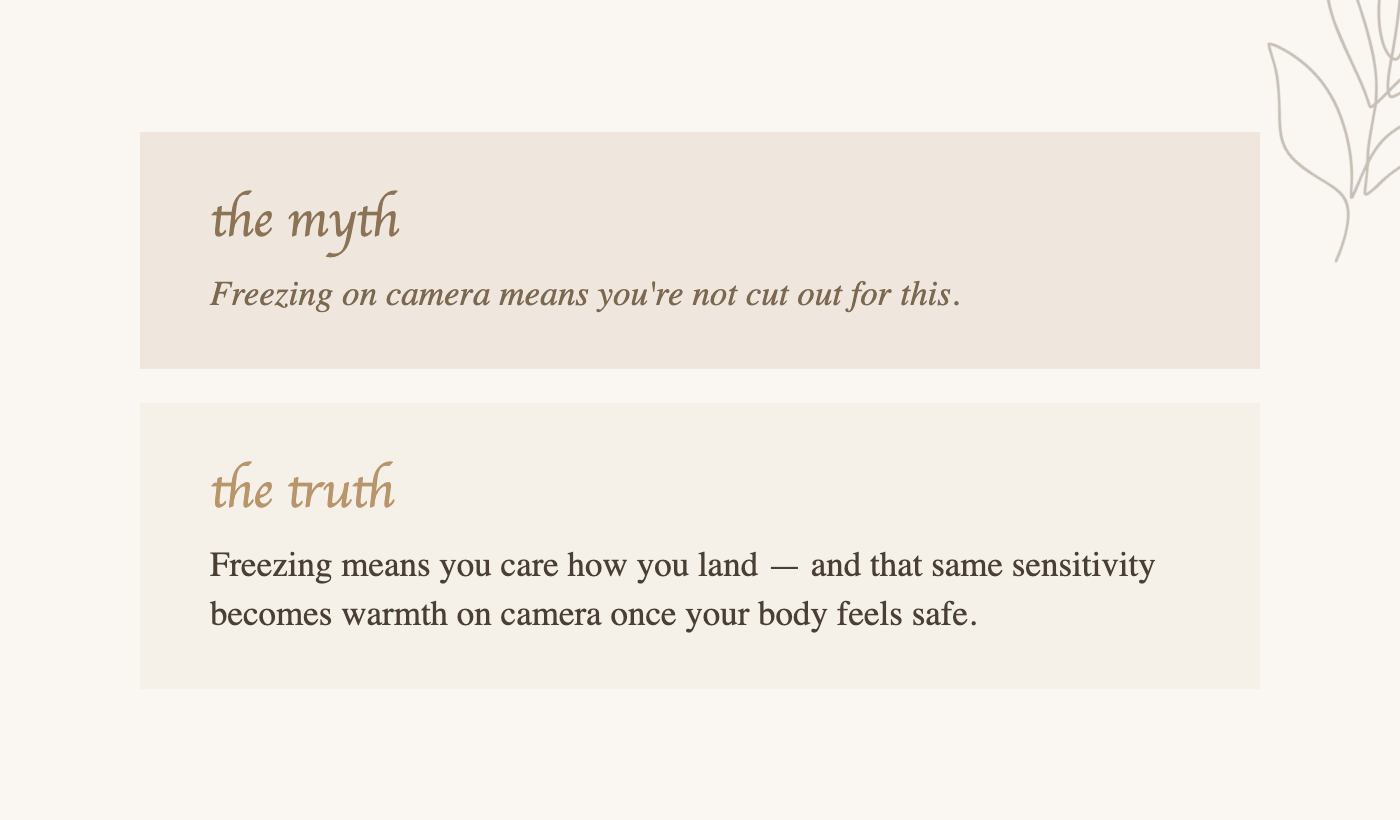
The myth: "freezing means I'm not cut out for this"
Let's put this one down for good.
You don't freeze about things you don't care about. Nobody's nervous system sounds the alarm over something meaningless. The freeze fires because this matters to you — because you care how you land, whether you're connecting, how your words feel on the other side of the screen. The people who freeze hardest are so often the ones who care most.
And here's what I've watched happen over and over: when the fear settles, that caring doesn't disappear. It changes shape. It becomes warmth. Presence. That quality where someone on a screen feels like they're talking directly to you. The exact sensitivity that's currently freezing you is the raw material of what will one day make you lovely to watch.
So no — you're not disqualified. You're early. Those are very different things. (And if the fear runs wider than the freeze — if being on camera at all feels like too much — start with how to overcome camera shyness, because that's the gentler, bigger picture this fits inside.)
Tonight, if you want, try the smallest version: one minute, one person you love in your mind, start talking before you feel ready, delete it after. That's it. That's the door.
Be seen. Be heard. Be authentically you.
Two minutes, a handful of honest questions, and you'll know exactly which zone you're in — and what to work on next.
Take the QuizFreezing usually means you're deciding too much in the moment. Compass makes those decisions before the camera's on — so there's nothing left to freeze about.
See How It Works