
You know exactly what you want to say. Then the little red light comes on — and suddenly you have no idea what to do with your hands.
I've watched this happen more times than I can count — someone who is magnetic in conversation. Hands painting pictures in the air. Leaning in when they get to the good part. The whole room leaning with them.
Then a camera comes on, and they say the same thing to the lens.
Arms drop to their sides like a soldier's. Shoulders climb toward the ears. The face goes carefully, politely blank. Same person, same words — and they land like a statement being read under supervision.
Nothing was wrong with her. Something very specific was happening to her body, and it happens to almost everyone: the moment we feel observed, we brace. In a room, a little bracing is invisible. On camera, it's the whole picture.
So here's what this post changes. Confident body language on camera is not something you put on — it's what's left when you take the bracing off. Twenty years of working in front of film cameras taught me that the actors who feel most alive on screen aren't doing more with their bodies. They're doing less, with softer edges. And every piece of it is learnable, from the ground up: posture, shoulders, hands, eyes, face. That's the order we'll go in.
Not sure what to film next? Creative Compass builds the plan with you.
The camera is an amplifier, not a mirror
First, the thing nobody tells you — and it explains so much: the camera exaggerates tension.
In a room, your listener takes in your whole presence — the space, the warmth, the fact that you laughed two minutes ago. A camera crops all of that away and hands the viewer a close-up. And at that magnification, small things get loud. What reads as "slightly stiff" across a dinner table reads as frozen on video. A politely still face becomes an unreadable one. A tiny clench in the jaw, invisible from three feet away, sits right there in the frame.
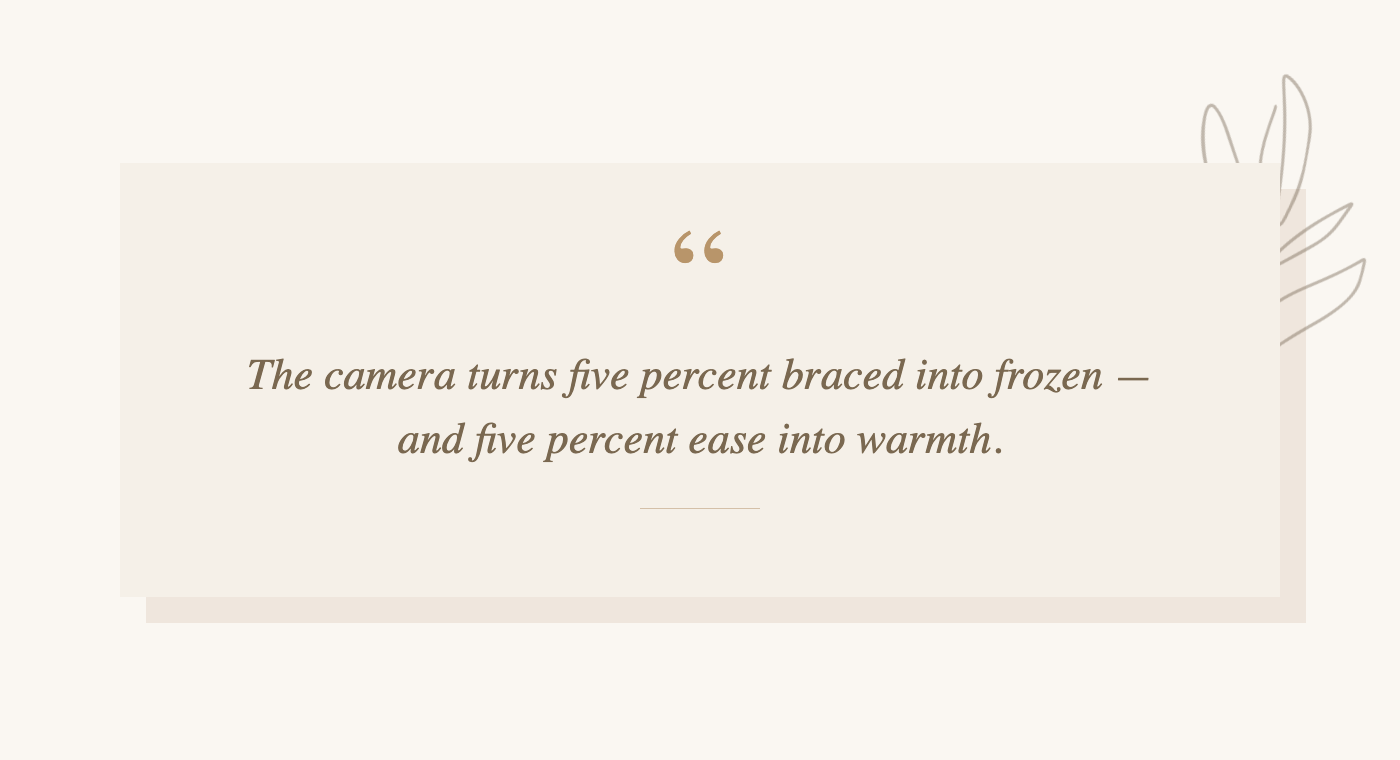
This is why so many people watch themselves back and think, why do I look so uncomfortable? I didn't feel that uncomfortable. You weren't wildly nervous. You were five percent braced — and the lens turned the volume up on it.
But the amplifier works both ways, and this is the good news. Ease gets magnified too. Genuinely soft shoulders, a real half-smile, one unhurried gesture — on camera, these read as enormous warmth. You don't need to become more expressive than you are at dinner with a friend. You need the camera to catch you the way that friend catches you.
Body language on camera: the ground-up reset
Do this in order, from your spine to your face. It takes about a minute before you press record — and eventually no time at all, because your body learns it.
Posture: tall, but soft
Rigid is not confident. Most of us were handed "sit up straight!" as the answer, and it produces exactly the wooden, held-breath posture we're trying to escape — locked muscles read as bracing, because they are bracing.
Try this instead. Grow tall through the back of your head — imagine a string lifting you gently from the crown — and then let everything else hang off that line. Sit or stand on your bones, not your muscles. Tall gives you presence; soft gives you life. You need both.
Then the shoulders, which are where camera nerves love to live. Take one slow breath in, and on the exhale, let your shoulders melt down away from your ears. Not pulled down. Released down. That single exhale changes more about how you read on screen than any outfit, angle, or light — because shoulders are the first thing a viewer's nervous system checks, long before they've processed a word you've said.
Hands: let them talk like they do at dinner
Here's a link I've never seen fail: locked hands make a locked voice.
Gesture and vocal warmth are wired together. Tell a friend a story over dinner and your hands are co-narrators — shaping, pointing, opening. And your voice, riding along with those hands, has music in it. Now clasp your hands tightly in your lap and tell the same story. Feel your voice flatten. The body is one instrument; clamp one part and the whole sound changes.
So the goal on camera is not "hand choreography." It's permission. Your hands already know how to talk. Your only job is to stop arresting them the moment the camera rolls.
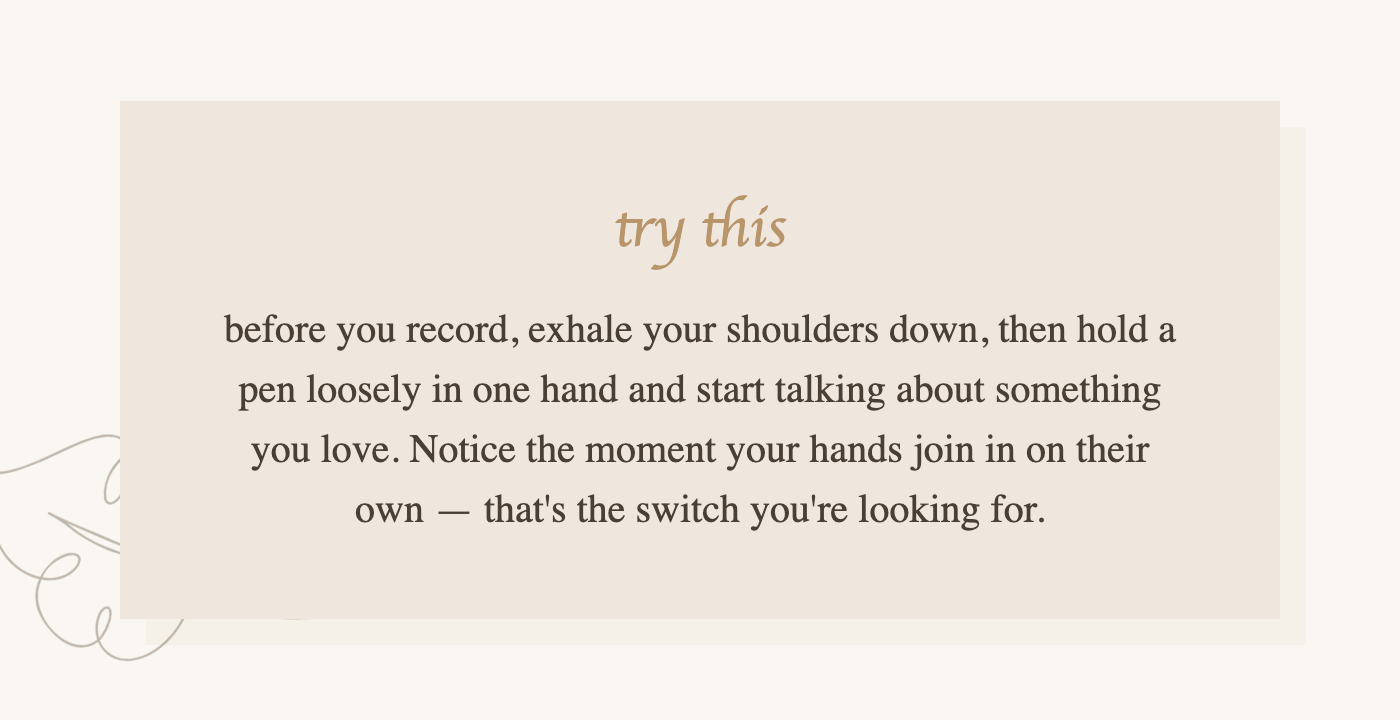
And when they feel alien anyway — because some days they will — give them a small honest task. Hold a pen. Rest them loosely on the desk or on your leg. Once they have somewhere unclenched to live, forget them completely. Parked hands free themselves the moment you get interested in what you're saying. Monitored hands never do.
Eyes: the lens is the person
Treat the lens as the person you're talking to — that's the whole skill of screen acting, compressed into one sentence. Not a device. Not an audience. One person, right there behind the glass, whom you happen to like.
And because it's a person, you're allowed to look away. This surprises people. They've been told "eye contact equals confidence," so they lock onto the lens and never let go — and constant lock-on doesn't read as confident. It reads as intense. Watch anyone in real conversation: when they reach for a thought, their eyes drift up or aside for half a second, then come back to you for the part that matters. Keep that. Think with your eyes away, land your point with your eyes home.
Where the lens sits decides where your eyes land, so set yourself up to succeed: raise the camera to your eye level — a stack of books under the laptop works — so you're meeting the viewer's gaze instead of looming over it. I've covered the full setup — angle, light, background — in how to look good on camera, and if most of your on-camera life happens in meetings, the eye-contact geometry of video calls gets its own treatment in how to look confident on Zoom.
The face: the exhale-smile
Your face carries tension you cannot feel. A jaw held one millimetre tight. A brow very slightly knit with concentration. In person, nobody notices. In a close-up, that micro-tension is the expression — and it reads as guarded, or stern, or worried, when all you were doing was trying hard.
The reset is one move, done just before you press record. Breathe out slowly, and as the exhale finishes, let your jaw unclench and a small smile arrive — not a posed one, just the face you'd make seeing a friend across a café. Actors do a version of this before nearly every take. The exhale releases the jaw and brow; the smile that rides in on the end of it is real, because relief is real. Press record inside that softness and your first seconds on screen are warm before you've said a word.
Movement: lean in, don't sway
Nervous energy has to go somewhere, and for most people it becomes sway — a gentle side-to-side rocking or a chair swivel. The viewer can't name it, but they feel it as unease.
Give the energy a better job. Make stillness your home base — soft stillness, the kind you built above, not a freeze — and then move on purpose: a small lean toward the lens when you get to the part you care about. That lean is one of the most powerful things a body can do on camera. It says come closer, this matters, the exact thing you do across a table when the story gets good.
On film sets we call the planned shape of movement "blocking," and I've come to think of blocking as kindness to the audience. When movement means something, the viewer's nervous system can relax — nothing is random, so nothing needs watching. Sway less, lean once. It's plenty.
What changes when the bracing goes
I want to be honest that this is not only mechanics. For most of us, the stiffness has roots — a fear of being seen that tightens the body before the mind has voted. The reset above works on the body directly, and the body reports back to the mind: see? safe. Both directions matter.
A member put it this way:
"I came to her because I want to create content, but noticed something blocking me from being authentic in front of the camera. In only the first session, she helped me uncover so much — guiding me through my thoughts, the source of the trigger. It was super valuable. I think everybody should do sessions with her."
— Mira N.
"Something blocking me" — that's the bracing, felt from the inside. It sits in the shoulders and the hands and the jaw, and it lifts the same way it arrived: piece by piece, with practice and a little company.
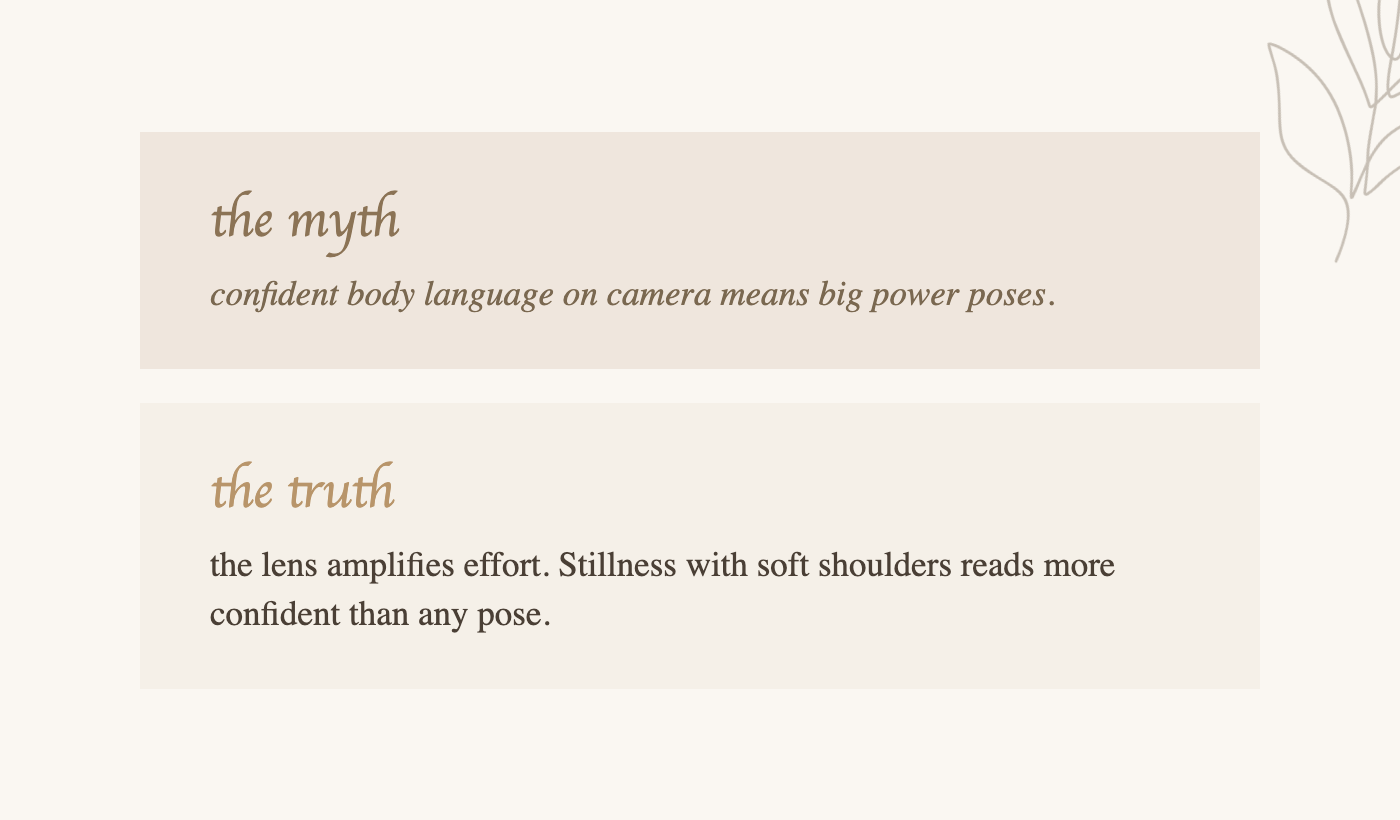
The myth: confidence means big power poses
You've seen the advice — stand like a superhero for two minutes, take up maximum space, project power. And maybe backstage before a big talk, a stretch and a shake-out genuinely help you.
But on camera? Posing is the opposite of what works. The lens is an amplifier of truth, remember — and a pose is a small untruth held with effort. Viewers can't articulate it, but they register the effort, and effort reads as nerves wearing a costume. Meanwhile the least dramatic thing imaginable — stillness with soft shoulders, hands at ease, eyes that leave and return like a real conversation — reads as more confident than any pose ever filmed. Confidence on camera doesn't look like power. It looks like nothing to defend.
Your body already knows how
Here's the quiet, wonderful truth: none of this is new skill. You already have confident body language — you use it every day, with people who make you forget yourself. The work isn't building something. It's removing the bracing that hides it.
So before your next video: string at the crown, shoulders down on an exhale, pen in hand, lens at eye level, exhale-smile, one lean saved for the good part. Then talk to one person you love and let the body do what it's always done.
And if you'd like to know exactly where you're starting from, the Camera Confidence Zone quiz takes three minutes and meets you there. You don't have to unbrace alone — it's easier, and honestly sweeter, with people practicing beside you.
Be seen. Be heard. Be authentically you.
Hands and posture settle once the shot is settled. Compass sets the framing and the distance first, so your body has somewhere to be.
See How It Works