
I've spent twenty years on film sets surrounded by lighting rigs that cost more than my first car. Here's what nobody tells you: the part that actually makes people look good is free.
The first time I filmed myself at home, I hated what I saw.
Which is ridiculous, right? I'd been on camera for two decades. Network television. A Hollywood blockbuster. Sets with entire departments whose only job was making actors look good. And there I was, alone in my bedroom with my phone propped on a stack of sweaters, staring at a grey, shadowy version of myself and thinking… who is that?
And then it clicked. On set, I never once thought about how I looked. Someone else had already decided where the light came from, where the camera sat, what was behind me. All I had to do was show up and connect.
My bedroom had none of those decisions made. That was the whole problem. Not my face. The decisions.
So if you've been searching "how to look good on camera" and bracing yourself for a shopping list — breathe. This post is the opposite of a shopping list. A film set gets three things right, and you can copy all three today, for free, with a window, a stack of books, and the phone already in your pocket. Then I'll tell you the part that matters more than all of it combined.
You don’t have to figure this out alone — come find your people.
How to look good on camera: copy what a film set gets right
Strip away the trucks and the cables and the people with clipboards, and a film set is really just three decisions made well: where the light comes from, where the camera sits, and what's behind you. Everything else is refinement. So let's make those three decisions for your room.
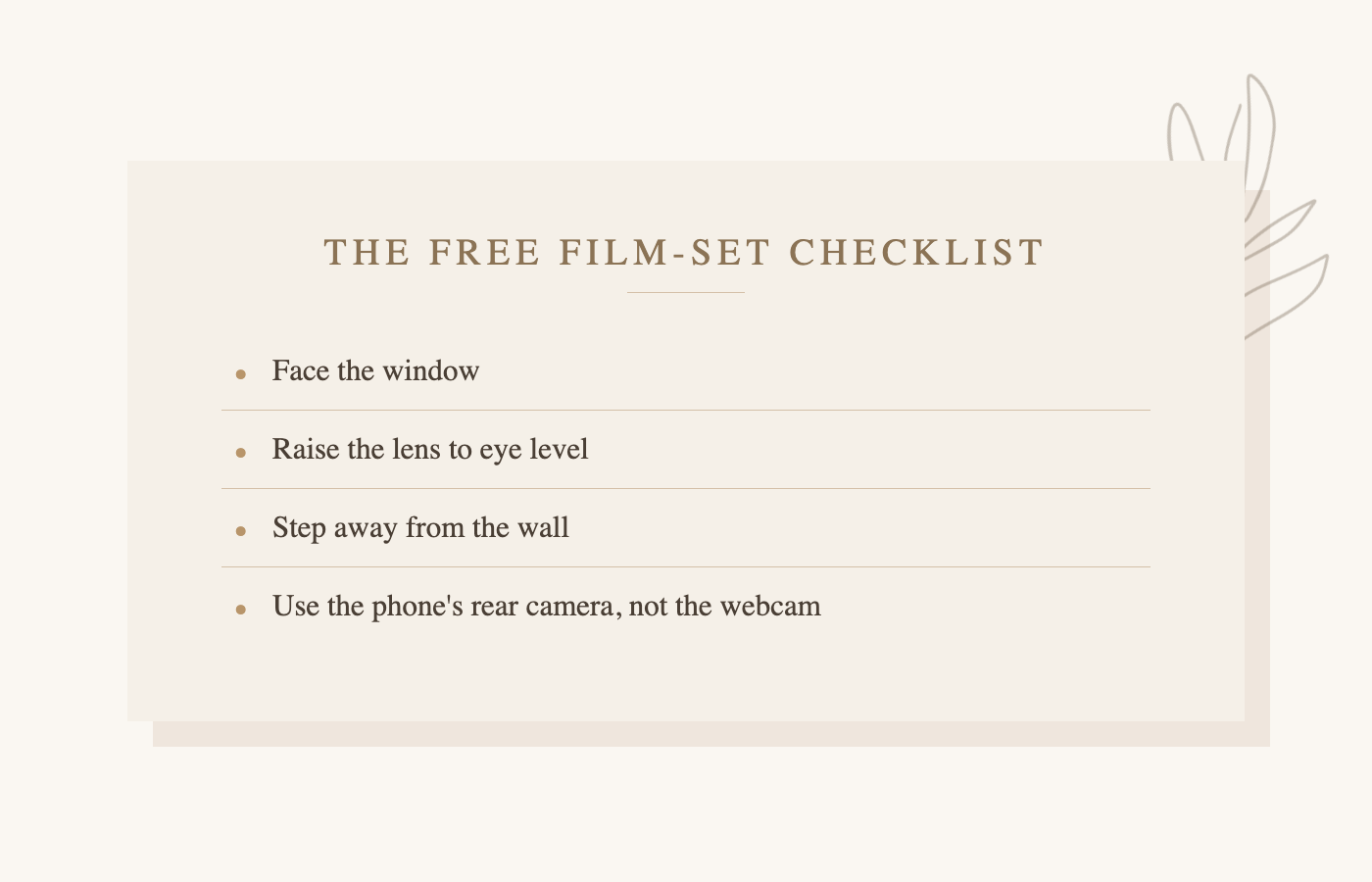
1. Face the window
The most important light on any set is called the key light — the big, soft, main source that shapes the actor's face. And I mean big. We're talking about a light pushed through layers of diffusion fabric until it's the size of a bedsheet, glowing softly, placed in front of the actor.
You already own one. It's called a window.
Turn your setup around so you are facing the window, with the camera between you and the glass. That's it. That's the adjustment that fixes more faces than any filter ever made. Soft, frontal daylight fills in the shadows under your eyes, evens out your skin, and puts a little catch of light in your eyes that reads as alive and warm.
The two mistakes I see everywhere: window behind you, which turns you into a mysterious silhouette, and window beside you, which lights half your face and leaves the other half in shadow — beautiful for a moody thriller, less ideal for "welcome to my channel." Face the light.
Bonus: an overcast day is a gift. Clouds are nature's diffusion. Some of the most flattering light I've ever been filmed in was a grey Vancouver sky.
2. Bring the camera up to your eyes
On set, the camera operator frames the lens at the actor's eye level for a simple reason: that's the angle of a conversation. Two people, eye to eye.
A laptop sitting on a desk films you from below — chin first, ceiling behind you, looking down at everyone watching. Nobody looks like themselves from that angle, because nobody has a conversation from that angle.
The fix costs nothing: a stack of books under the laptop. A shoebox under the phone. Raise the lens until it's level with your eyes, so the camera meets you the way a person would. You don't need a tripod to start. I filmed for months with my phone leaning against a pile of cookbooks, and it worked because the lens was in the right place. This exact trick, by the way, is half the battle on video calls too — I go deeper on that in how to look and feel confident on Zoom.
3. Step away from the wall
Film sets are built with depth on purpose: something in the foreground, the actor in the middle, the world going on softly behind them. Depth is what makes an image feel like a place instead of a backdrop.
When you sit with your back against a wall, you get the opposite — a flat, evenly lit slab right behind your head, with your own shadow stamped onto it. It reads like a passport photo.
So step forward. Two or three feet of air between you and whatever's behind you. The background softens a little, your shadow falls away out of frame, and suddenly the shot has dimension. And no, the background does not need to be styled. A lamp, a plant, the corner of a bookshelf. You're after depth, not decor. Nobody has ever stayed for the bookshelf — they stay for you.
The 80% rule: light beats gear, every single time
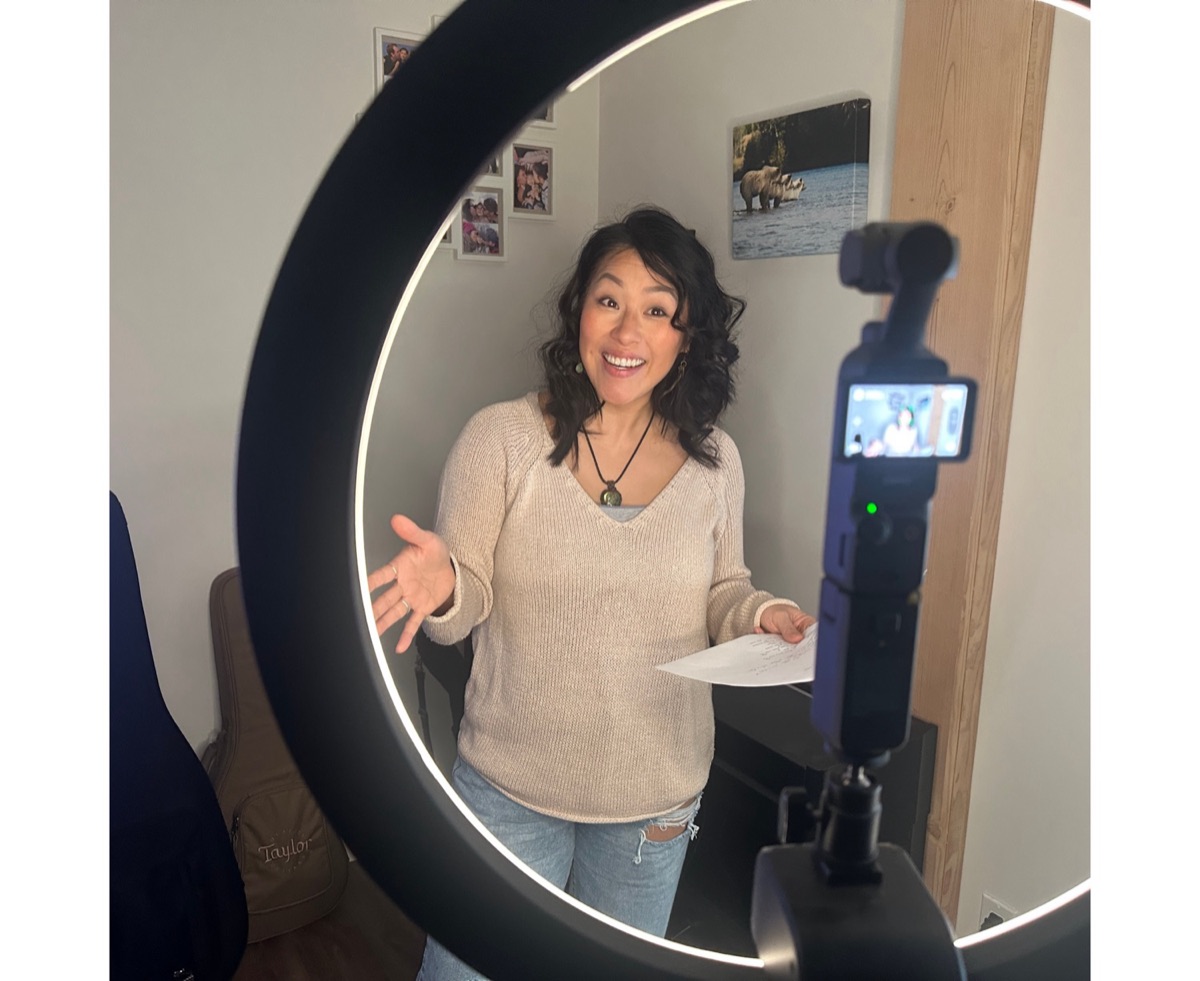
Here's a rule I'd tattoo on every new creator's tripod if I could: your lighting is about 80% of how good you look on camera. The camera itself is a rounding error.
A phone in good window light will beat a two-thousand-dollar camera in a dim room every day of the week. I have watched it happen. Modern phones carry cameras that would have made a producer weep twenty years ago — and the rear camera, the one on the back, is significantly sharper than the front-facing one, and better than almost any webcam sold today.
Yes, using the rear camera means you can't see yourself while you record. I know that feels scary. It is secretly a gift — because the person you're talking to can't see themselves either, and the moment you stop monitoring your own face is usually the moment you start actually talking to someone. Point the good lens at yourself, trust your setup, press record.
The part that matters more than lighting
Now the deeper thing. The thing the setup articles never say.
Looking good on camera is mostly looking comfortable on camera. Tension is the most visible thing you can wear. Lifted shoulders, a held breath, a smile that's working too hard — the lens picks all of it up and quietly hands it to your viewer, and no amount of gorgeous window light covers it. I've seen impeccably lit footage of someone bracing for impact, and I've seen slightly-too-dark phone videos of someone completely at ease. The at-ease person wins. Every time.
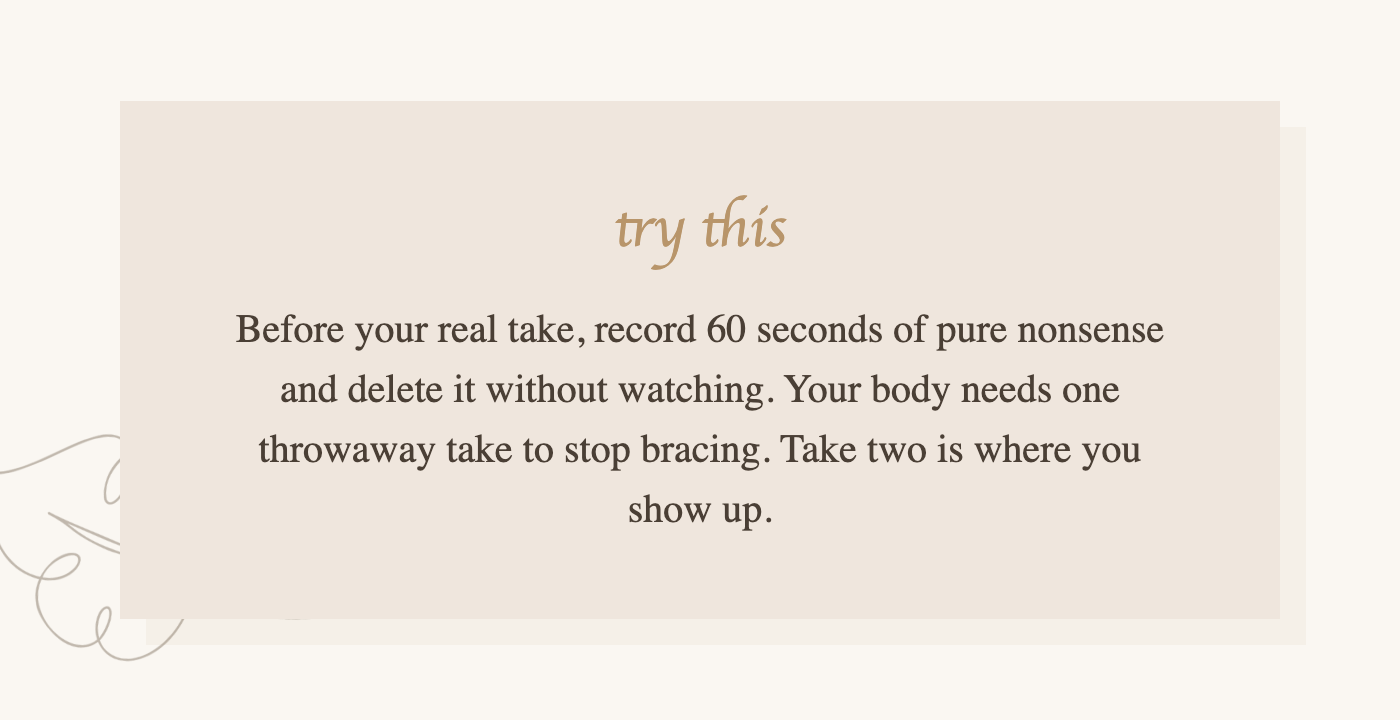
Even professional actors aren't comfortable in take one. On set, the first take is almost always a warm-up — the body settling, the breath dropping, the performance finding its feet. Nobody expects take one to be the keeper. So why do you expect your very first press of the record button to be?
Give yourself a throwaway take. On purpose. Sixty seconds of nonsense — what you had for breakfast, in your silliest voice — recorded and then deleted, no review, no judgment. Your nervous system needs one take to learn that nothing bad happens when the red light is on. Take two will look better than anything a light could do for you.
Comfort has one more ingredient, and it hangs in your closet — clothes you forget you're wearing beat clothes that photograph well. I wrote a whole simple guide on what to wear on camera so you can settle that question once and stop thinking about it.
You don't have to figure this out alone
If all of this feels less like a gear problem and more like a fog problem — where do I even start, is it my setup, is it me — you're in very good company. A member of our community put it this way after one conversation:
"It was amazing the way Elfina was able to steer me towards more clarity and next steps! She somehow managed to change my dread, doubt, and fogginess into fresh desire, doable first steps, and belief that maybe I can actually get this 'video stuff' off the ground!"
— Lisa Ann
Dread, doubt, and fogginess. That's the honest starting point for almost everyone — including, once upon a time, a professional actor sitting in her bedroom hating her own footage. Clarity isn't a personality trait. It's a next step, taken.
The myth: "I need a ring light and a better camera first"
Let me say this with love, because I've watched it steal months from people I care about: gear is the most expensive way to avoid pressing record.
The research spiral feels productive. Comparing cameras, reading lighting reviews, waiting for the tripod to arrive. But it's the same fear of being seen, wearing a very convincing disguise. There will always be one more thing to buy before you're "ready," because ready was never for sale.
And here's the kicker: the window you already have gives softer, more natural light than most ring lights — which tend to flatten faces and leave telltale white circles in your eyes and glasses. The phone you already own out-films most webcams. If you fall in love with making videos and want to upgrade later, wonderful. Buy gear because you're creating so much that it's earned, not because you're hoping it will make the fear go away. It won't. Pressing record is what makes the fear go away.
You already have everything you need
Face the window. Raise the lens. Step off the wall. Use the phone you own. Waste one take on nonsense, then talk to one person you care about.
That's the entire film set, folded into a bedroom. Twenty years of very expensive lighting knowledge, and the honest translation is: turn around, look at the light, and let yourself be a little imperfect on purpose.
If you're not sure whether it's your setup or your nerves standing between you and the record button, the Camera Confidence Zone quiz takes three minutes and will tell you exactly where you are — and what to do next.
Be seen. Be heard. Be authentically you.
Practise everything in this post alongside people cheering you on — that's what the community is for.
Join the Community