
You've been in the meeting for forty minutes, and you couldn't repeat the last thing anyone said — because you've spent the entire call watching one face. Yours.
I remember catching myself doing it.
Twenty years on professional film sets. Cameras the size of microwaves pointed at my face while I delivered lines to Freddie Highmore. And there I was on a video call, nodding along to someone's quarterly update while my eyes stayed locked on my own little square — is my hair doing that thing, why is my face so grey, do I always tilt my head like that?
Here's the strange part: on set, I never watched myself. I couldn't. There's no monitor pointed at the actor. All my attention went out — to the other actor, the scene, the moment.
Zoom reverses that. It bolts a mirror to every conversation and then asks you to concentrate. No wonder you come off calls exhausted and vaguely embarrassed for reasons you can't name. You weren't in a meeting. You were in a forty-minute audition you were also judging.
So this post is two halves, because "how to look confident on Zoom" is really two questions. The first half is setup — five small mechanical fixes, borrowed from film sets, that make you look present and put-together with zero new gear. The second half is the feeling underneath, because video-call anxiety is not a separate condition. It's camera shyness in office clothes. Same fear of being seen. Same fixes.
Not sure where you’re starting from? Find your Camera Confidence Zone — it takes two minutes.
How to look confident on Zoom: five fixes before your next call
None of these take more than two minutes. Together, they change how every call feels from the inside.
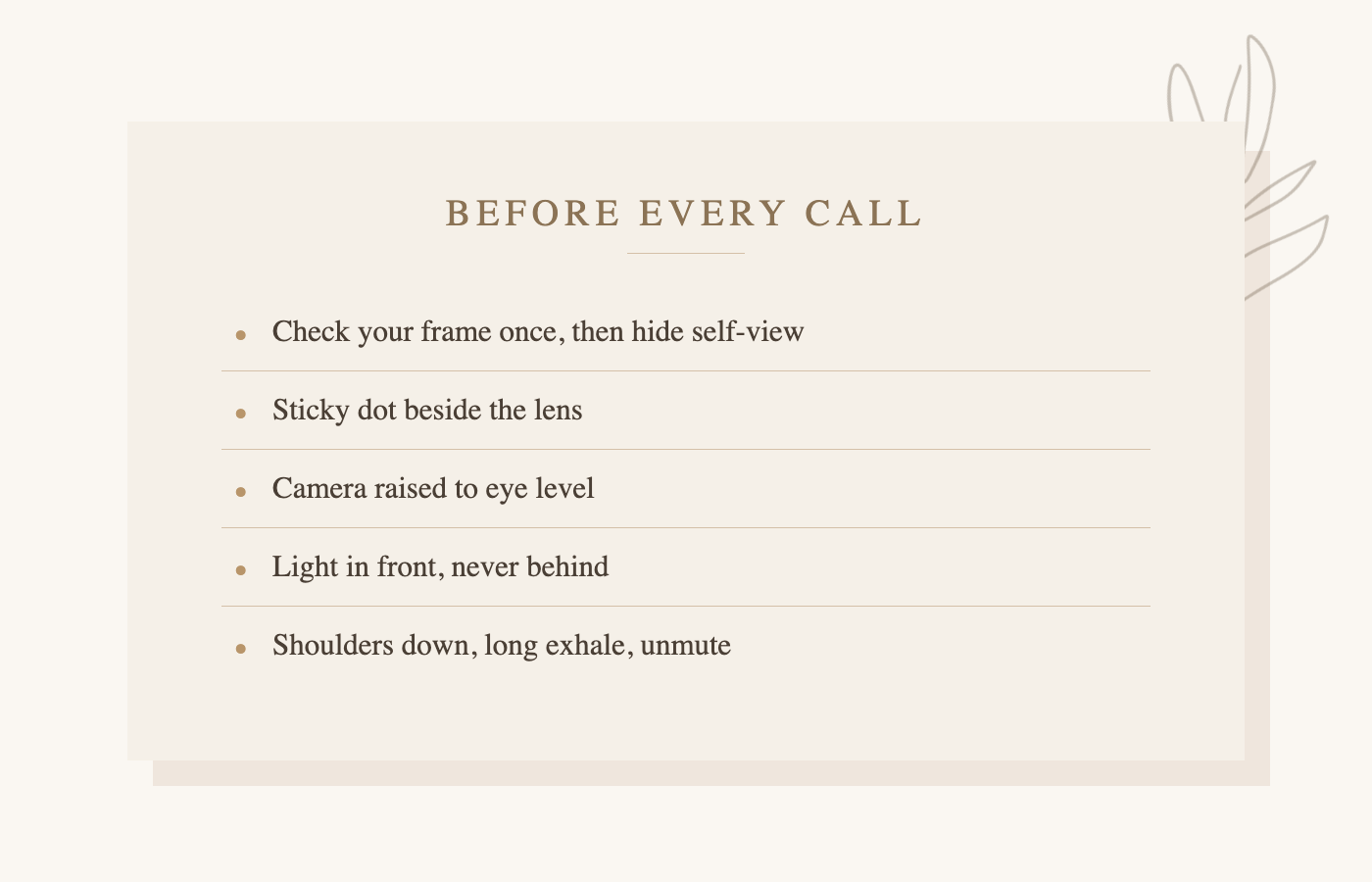
1. Check your frame once — then hide self-view
Before the call, open your camera preview and take ten seconds: light okay, frame okay, nothing strange behind you. That's your one look. Then, once you've joined, hide self-view. In Zoom, hover over your own video, click the three dots, choose "Hide self view." Others still see you — you just stop seeing you.
This is the single biggest confidence upgrade available on a video call, and it's free and instant. You cannot give people your full attention while a mirror of your own face flickers in your peripheral vision; your brain will check it, involuntarily, every few seconds, the whole meeting. Actors don't perform in front of mirrors for exactly this reason. The moment you're watching yourself, you're split — half of you in the conversation, half of you in the audience of it. Hide the square, and something quietly settles. You stop performing attention and just… attend.
2. Look at the lens, not the faces
Here's the cruel geometry of video calls: when you look at people's faces on screen, you appear — on their screen — to be looking down and away. The only way to "make eye contact" through a camera is to look at the camera. The tiny dot at the top of your laptop. Not the gallery of humans below it.
This feels wrong at first. Every instinct says look at the faces. But this is the exact skill screen actors are trained in: treating a piece of glass as a person. You don't need to hold it for the whole call — that would be strange for you and oddly intense for them. Just return to the lens for the moments that matter: when you're speaking, when you're greeting, when you want someone to feel heard.
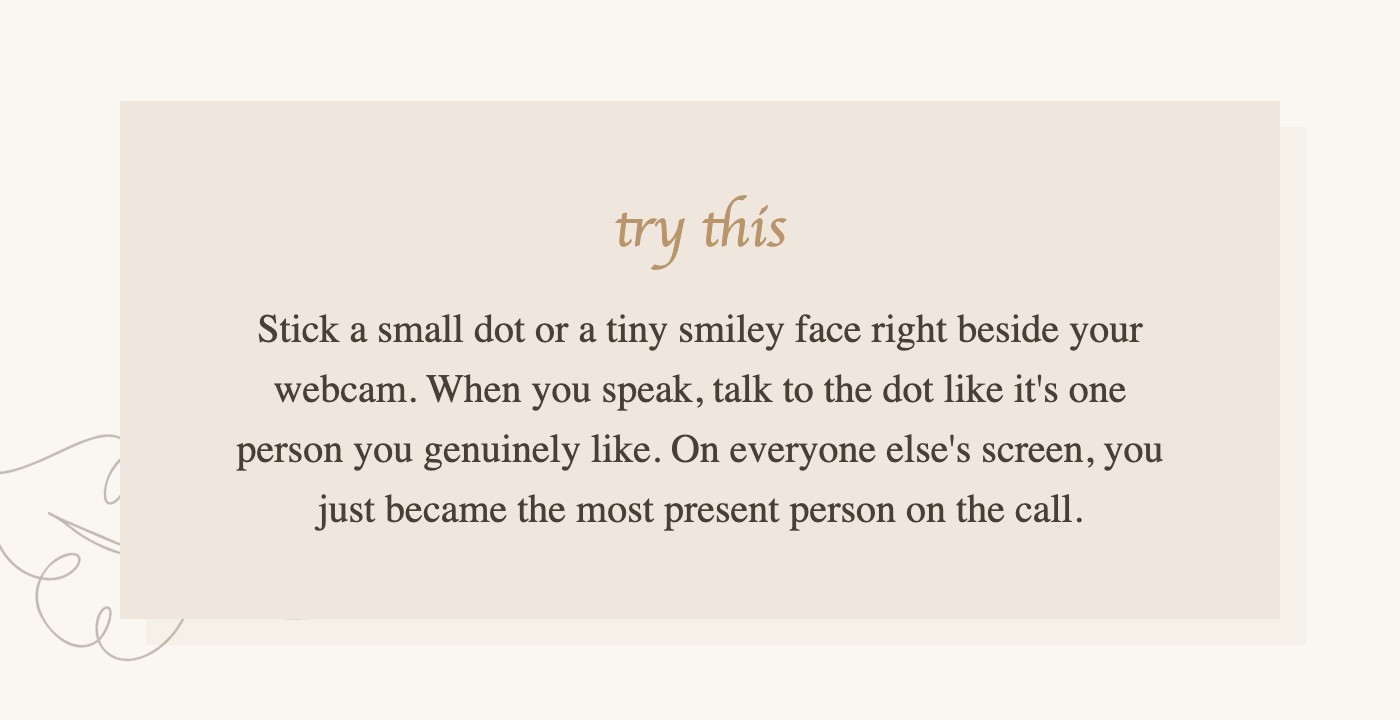
The film-set trick that makes it easier: put a small sticky dot — or a tiny drawn smiley face — right next to your camera. Actors do a version of this constantly, giving the lens something human to aim at. When you talk to the dot, everyone on the call suddenly feels like you're talking to them.
3. Raise the camera to eye level
A laptop on a desk films you from below — the chin-and-ceiling angle, gazing down at everyone like a disappointed monarch. No one has ever had a warm conversation from that angle.
Put a stack of books under the laptop until the lens sits level with your eyes. That's it. Eye level is the angle of every conversation you've ever had, which is why it instantly reads as natural, engaged, and — yes — confident. On set, this isn't even a decision; the camera comes to the actor's eyes, always.
4. Put the light in front of you, not behind you
If you look like a shadowy silhouette on calls, it's not your face. It's that the brightest thing in the room is behind you, and the camera is exposing for the window instead of for you.
Turn your desk around so you face the window and the light lands on your face. Softest, most flattering light you can get, and it costs nothing. No window available at call time? A lamp behind your laptop, pointed at you, does an honest version of the same job. This is the same principle that carries every filming setup, by the way — if you want the full free version of the film-set treatment, angles and background included, it's all in how to look good on camera.
5. The reset before you unmute
This one is invisible, and it might matter most.
Before you speak — while your hand is moving to the unmute button — do two things. Drop your shoulders away from your ears. Then take one slow breath out. Longer exhale than inhale.
Backstage, before a take, you'll see actors doing exactly this in their own ways: shaking out hands, rolling shoulders, one long breath. It's not superstition. A long exhale tells your nervous system there's no emergency, and the body listens faster than the mind does. Speaking on a held breath is what produces that tight, rushed, slightly-higher-than-normal meeting voice you've heard from yourself. Speaking after an exhale produces your actual voice.
Sit up on your sitting bones, shoulders easy, one breath out, unmute. Twenty seconds. It reads on camera as calm. It feels like calm, because it is.
The feeling underneath: it was never about Zoom
Now the honest half.
If your stomach tightens when the meeting link opens — if you angle your camera up at the ceiling, or keep it off and hope no one asks — the settings above will help, truly. But you and I both know the settings aren't the whole story.
Video-call anxiety is camera shyness wearing office clothes. It's the same fear of being seen that stops people from filming videos, just scheduled into your calendar four times a day. The freeze when attention turns to you. The replaying of the thing you said an hour after the call. The exhaustion that isn't about the work at all — it's about holding a performance for hours.
I know that fear from the inside. I've been behind a camera for twenty years, and I still felt sick the first time I turned one on myself, alone, with no director and no script. What helped wasn't more polish. It was learning to stop performing and start connecting — talking to one person instead of managing an audience. On a Zoom call, that person is right there: whoever's speaking, whoever needs to hear you. The dot beside your lens. One person. Watch what happens.
And because it's the same fear, it responds to the same work. Every bit of gentleness you build in front of a camera shows up in your meetings, and the reverse is true too — those daily calls are quiet practice for being seen. I've written more about the roots of it in how to overcome camera shyness, and everything there applies to the little square with your name under it.
One of our community members described what the other side of this feels like:
"Just had a zoom call with Elfina and it was so much more than I ever expected! I felt for the first time what it is like to be in a meditative state. One hour and wow!! I can ACTUALLY meditate. Calm. Confident. And excited. She is absolutely amazing! Thank you so much for today, Elfina! xo"
— Sarah H.
Calm. Confident. And excited. On a Zoom call. That's not a personality some people are born with — it's what's underneath the bracing, once the bracing isn't needed anymore.

The myth: everyone is scrutinizing your square
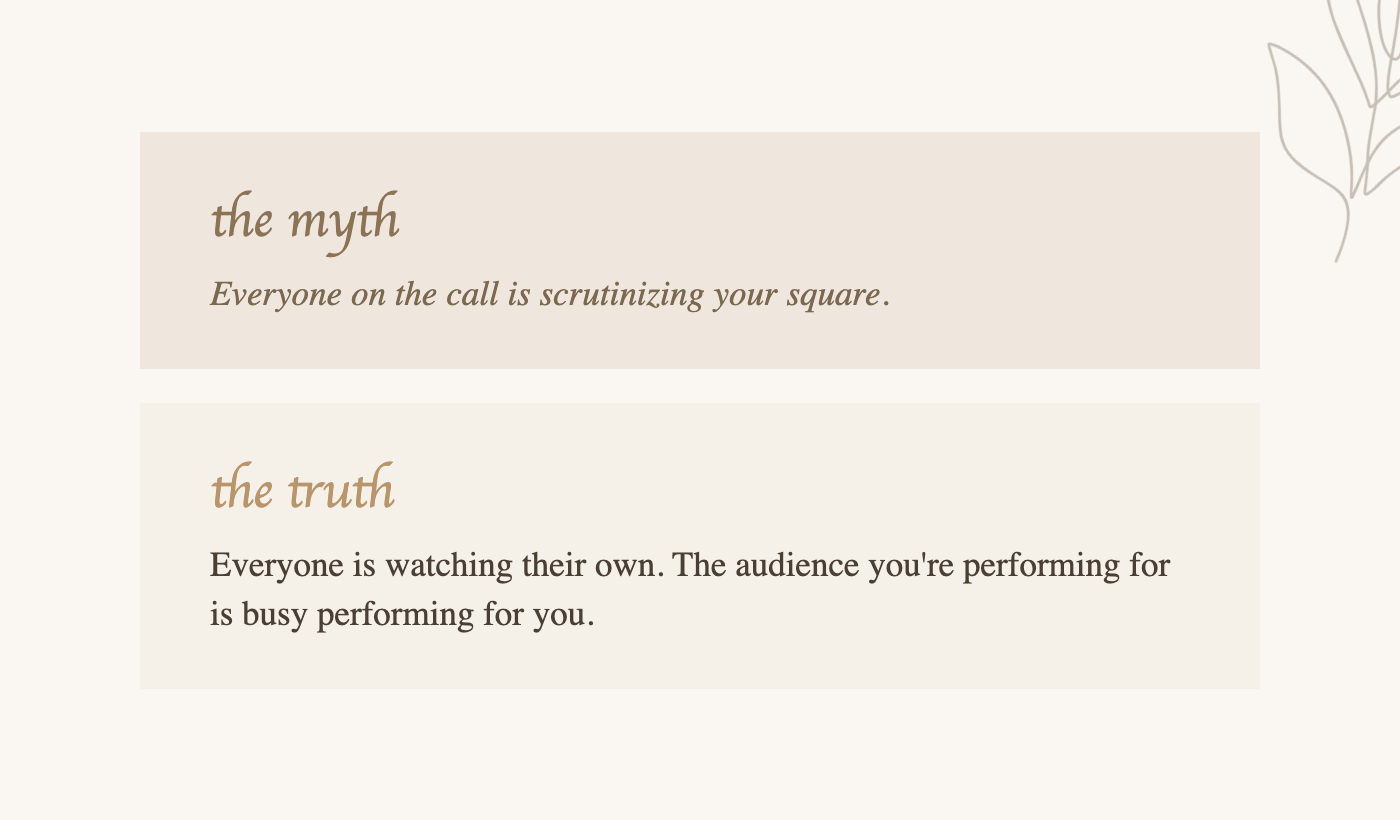
Here's the belief driving most video-call dread: twelve people, all quietly evaluating your face, your room, your weird pause before answering.
Now be honest about your own last meeting. Whose square were you watching?
Yours. Almost everyone answers yours. Which means the grid of people you're afraid is studying you is a grid of people studying themselves — each one starring in their own private audition, with barely a spare thought for anyone else's. Psychologists call the general version the spotlight effect: we dramatically overestimate how much others notice about us. Zoom is the spotlight effect with a literal mirror attached.
Nobody is scrutinizing your square. They're too busy scrutinizing their own. Truly absorbing this is like setting down a bag you didn't know you were carrying — the performance was for an audience that was never watching.
The next call is practice
So here's your next meeting, reimagined. Frame checked once, self-view hidden. A silly little dot beside the lens. Camera at eye level, window in front of you. Shoulders down, one long breath out, unmute — and talk to one person like they matter, because they do.
You have, what, three of these calls tomorrow? That's three chances to practice being seen in the lowest-stakes way there is. Not performing presence. Just being present, in a little square, on an ordinary Tuesday. That practice compounds into everything — the video you've been meaning to film, the introduction you've been putting off, the message you keep almost sharing.
If you'd like to know exactly where you're starting from, the Camera Confidence Zone quiz takes three minutes and tells you what your next step is — on calls, on camera, all of it.
Be seen. Be heard. Be authentically you.
Two minutes, a handful of honest questions, and you'll know exactly which zone you're in — and what to work on next.
Take the QuizPractise everything in this post alongside people cheering you on — that's what the community is for.
Join the Community