
You press record, open your mouth to say your own name — a name you've said your entire life — and somehow it comes out sounding like someone else's.
I know that moment well. As an actor, I've slated hundreds of auditions. A slate is the little intro at the top of a self-tape: "Hi, I'm Elfina Luk, Vancouver." Ten words. And for years, that was the part I re-recorded most. Not the scene. Not the emotional monologue. The part where I said my own name.
Then, years later, I sat down to film my first coaching video, and it got worse. I opened with everything I thought made me worth listening to. Twenty years of acting. The credits. The training. I watched it back and cringed. It didn't sound like me. It sounded like a résumé that had learned to talk.
So I deleted it. And then deleted the next one. And the one after that.
Here's what this post will change for you: by the end, you'll know how to introduce yourself on video with a simple shape for the first ten seconds — one that doesn't feel awkward, doesn't sound like a bio being read out loud, and actually makes people stay. Because the problem was never you. The problem is that you were taught to introduce a résumé, when the person watching just wants to be greeted like a human.
You don’t have to figure this out alone — come find your people.
Why your intro collapses in the first sentence
Think about the last time you met someone lovely at a dinner. Did they open with their job title, their years of experience, and a list of certifications? Of course not. They said hi. They noticed something about the moment you were both standing in. They made the conversation about the two of you.
Now think about how most of us start videos: "Hi, my name is ___, I'm a ___ with ___ years of experience, and today I'm going to be talking about ___."
That's not a greeting. That's a cover letter.
And your body knows it. That's part of why you freeze. In that first sentence you're performing a version of yourself that doesn't exist anywhere else in your life — nobody talks like that at the kitchen table. So when the red light comes on and you reach for those words, there's a gap between who you are and what you're saying. That gap is where the awkwardness lives. It's also why so many people can chat easily for an hour and still stumble over their own name on camera.
The viewer feels the gap too. They clicked because something in them asked, "Is this for me?" A résumé doesn't answer that question. A person does.
How to introduce yourself on video: start with them, not you
Here's the flip that changes everything. Before you say your name, name their moment.
"If you've ever frozen mid-sentence on camera, you're in the right place. I'm Elfina."
Feel the difference? Before I've said a single thing about myself, the person watching knows two things: I see them, and this is for them. My name arrives second, and by then it lands differently — not as a claim to authority, but as a hand extended. You're safe here. I'm Elfina. Come on in.
This works because of the order. Their moment first. Your name second. One warm line of why-you third. That's the whole intro. Everything else — the credentials, the backstory, the "so a little bit about me" — can wait, or honestly, can go.

The you → me → us shape
If you like a structure to hold onto, here's the one I come back to again and again.
You — name the moment they're in
One sentence that describes the exact feeling or situation that brought them to this video. Not their demographic. Their moment. "If you rewrote your caption four times and still didn't post the video…" "If you know exactly what you'd say to a client but go blank the second you hit record…" Specific enough that the right person thinks, oh — that's me.
Me — your name, said like you'd say it to a friend
Just your name. "I'm Elfina." Not "My name is Elfina Luk and I am the founder of…" The shorter it is, the more confident it sounds. Strange but true.
Us — one warm line of why-you
One line that tells them why you're the person to walk them through this — and here's the key: warm specifics beat titles every time. "I'm a certified confidence coach with two decades of experience" is a title. "I've spent twenty years in front of cameras, and I still remember the day one stopped scaring me" is a person. Both are true about me. Only one of them makes you lean in.
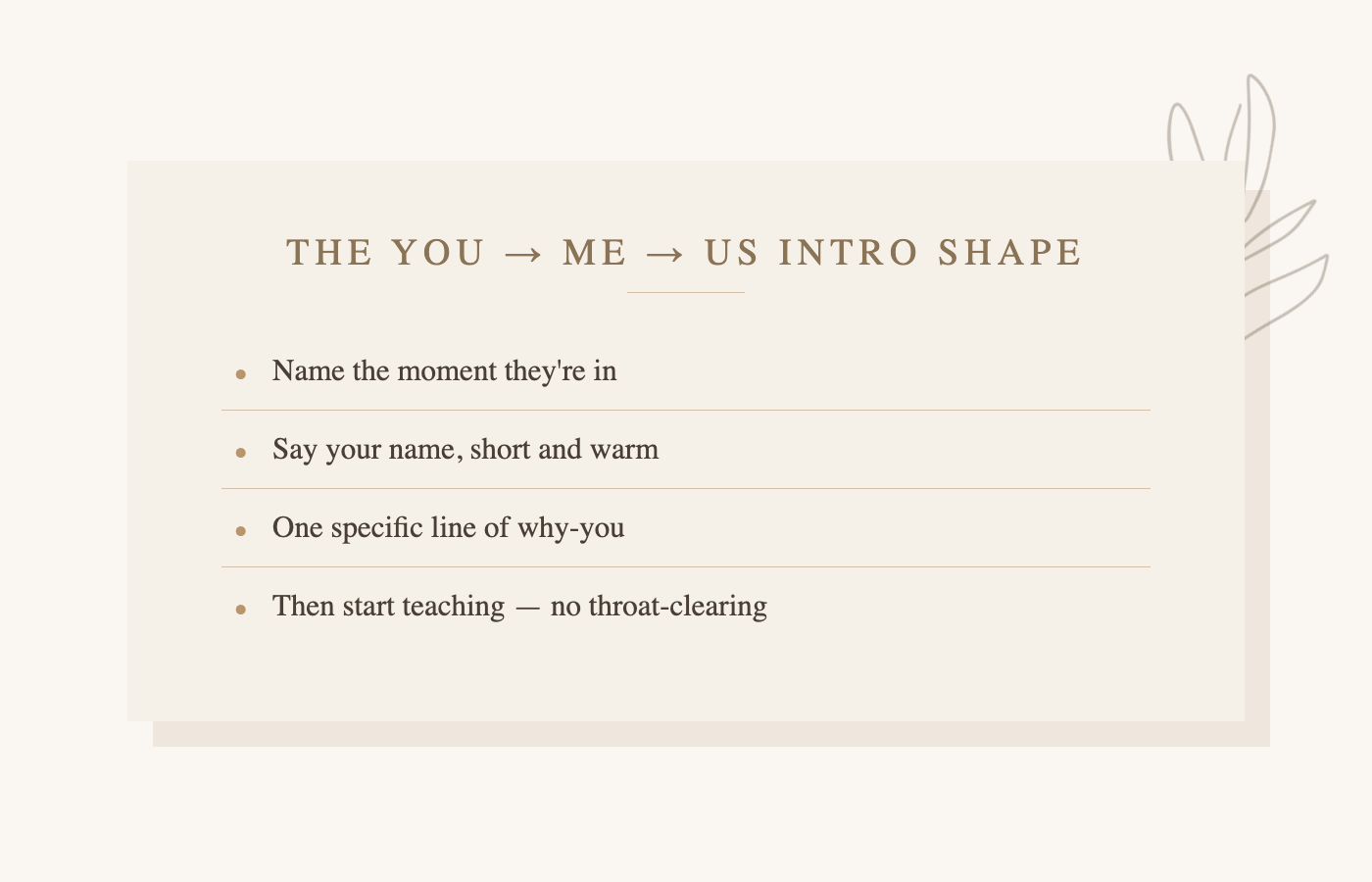
Ten seconds. Three beats. And notice what's not in it: no "welcome back to my channel," no "before we start," no apology for the lighting. The you → me → us shape gets you to the good part while the viewer is still deciding whether to stay.
What actors know about first entrances
Here's something twenty years on set taught me: the audience decides how to feel about a character before that character finishes their first line. Before. Not after they've proven themselves. Not once the writing gets good. The decision happens in the walk through the door, the first breath, the first half-sentence.
Directors know this, which is why actors are never really "starting" a scene when the camera rolls. We enter already in motion — already mid-thought, already in relationship with the people in the room. The scene began, in our bodies, before anyone was watching.
You can borrow this. Don't start your video from a cold, formal standstill and try to warm up as you go — by the time you've warmed up, they've decided. Instead, walk in already talking to a friend. Before you press record, say a sentence or two out loud to someone you love, as if they were in the room. Then hit record mid-warmth and let the intro come out of that energy. You're not beginning a performance. You're continuing a conversation.
That's really what all of this is — not a trick, just being yourself a few seconds earlier than feels natural. If that idea of "just be yourself" has always felt easier said than done, I wrote a whole post on how to be yourself on camera, because it's a skill, not a personality trait.
The three-takes drill
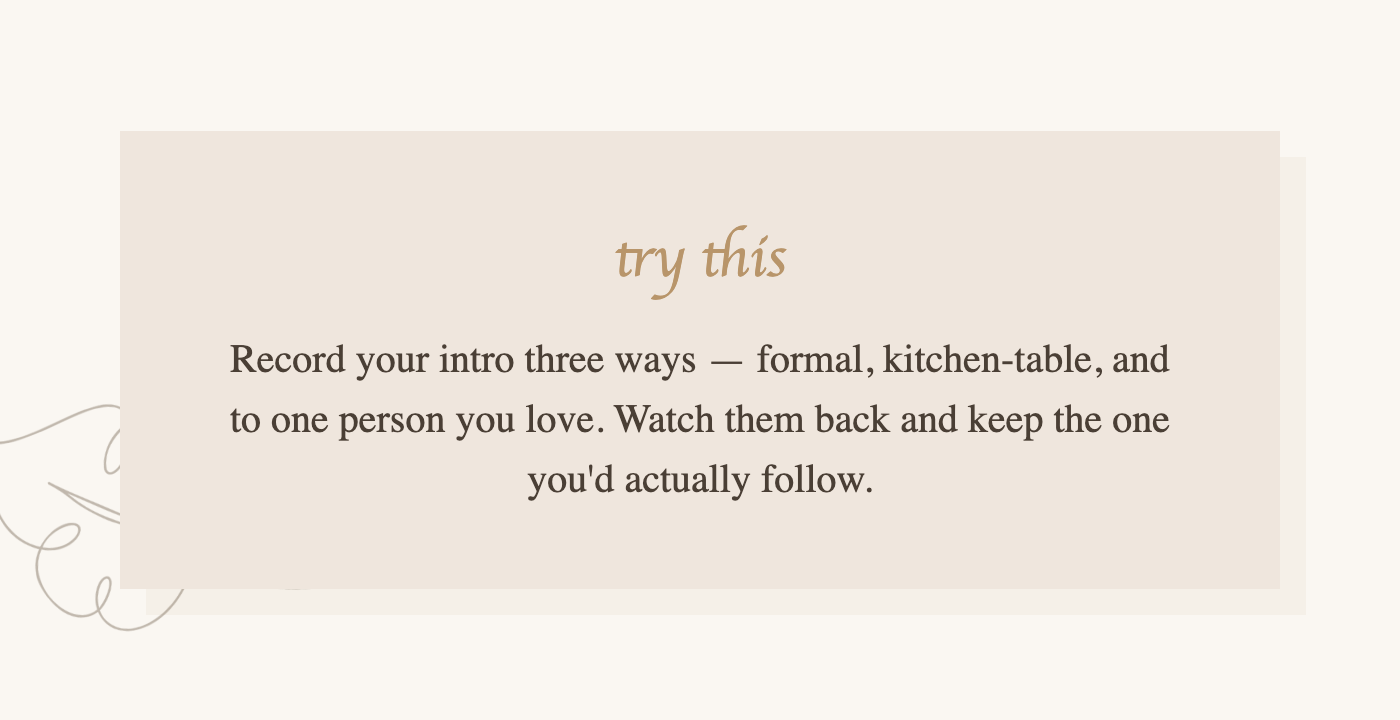
Reading about intros won't change your intros. This will. Set aside ten minutes, prop up your phone, and record the same introduction three different ways:
- The formal take. Full title, credentials, "my name is," the works. The version you think you're supposed to do.
- The kitchen-table take. Imagine a friend just sat down across from you with a cup of tea and asked what you do. Answer them. That's the take.
- The one-person-you-love take. Picture one specific person you adore — your sister, your best friend, your kid — and introduce yourself to a stranger the way you'd want that person to hear you do it. Soft. Unhurried. A little smile in it.
Then watch all three back and ask one question only: which one would I keep watching?
Not which one sounds most professional. Which one would you follow, if you stumbled on it at 10pm scrolling on the couch?
I've watched a lot of people do this drill, and the kitchen-table take wins almost every time. Not because it's polished — because it's inhabited. There's a person in it. And one honest note: watching yourself back is its own hurdle, especially if you hate the sound of your own voice. That reaction is normal, it has a name, and it softens with exposure. Don't let it stop you from doing the drill — the drill is how it softens.
Proof it's not just me saying this
The résumé-mode freeze is so common that I hear versions of it constantly. A member of our community put it this way:
"Before her program, I felt like a robot in front of the camera. I would blank out and block my own way to progress. After, I easily let my personality shine through, while getting what I want the content to convey across! 10/10, thanks again Elfina!"
— Kat O.
A robot. That's exactly what résumé-mode feels like from the inside — reciting instead of relating. And notice what changed for her: not her credentials, not her equipment. She let her personality through. The information still landed. It landed better.
The myth: "a strong intro lists your credentials"
Let's take this one apart gently, because I believed it for years.
Credentials earn trust on paper. On a résumé, a website, a speaker bio — list away. Those are formats where the reader is scanning for qualifications, and credentials answer the question being asked.
But on camera, the viewer isn't asking "is this person qualified?" They're asking "do I want to be in a room with this person?" And warmth answers that question in a way no title can. Warmth earns trust on camera. Your credentials can absolutely come up later — woven into a story, mentioned in passing, sitting quietly in your caption. By then, the viewer has already decided they like you, and the credentials confirm the decision instead of making the pitch.
Leading with the résumé doesn't just fail to build trust. It actively costs you the ten seconds when trust is actually being decided.
Say your name like you're glad they came
Here's what I want you to take with you, because how to introduce yourself on video really comes down to this: the first ten seconds aren't an audition. They're a doorway, and you're the one holding it open. Name the moment your person is standing in. Tell them your name the way you'd say it across a kitchen table. Give them one warm reason to walk through with you.
And then practice it — out loud, three ways, this week. Not until it's perfect. Just until the kitchen-table version stops feeling like a risk and starts feeling like yours.
You don't have to figure this out alone, either. Practicing intros into the void is hard; practicing them with people who are cheering for you is a completely different experience. That's exactly what our community is for — and if you're curious what's actually going on underneath your camera nerves first, the Camera Confidence Zone quiz is a gentle two-minute place to start.
Be seen. Be heard. Be you. Starting with your name.
Practise everything in this post alongside people cheering you on — that's what the community is for.
Join the Community