
Twenty years on set taught me something strange: you can hear confidence before you can see it.
Close your eyes for a second and think of someone whose presence you trust. A favourite teacher. A director who calmed the whole room. That one friend who makes everything feel figure-out-able.
Now ask yourself — what do you actually remember? Probably not their posture. Not their lighting, definitely not their outfit. You remember how they sounded. Steady. Unhurried. Like they had time for you.
I've stood on sets with some of the most magnetic actors working today, and here's the secret nobody tells you: the camera barely matters. The microphone is where confidence lives or dies.
So if you've been searching for how to speak confidently on video, I have genuinely good news. You don't need a new personality. You don't need a voice transplant. You need three levers — breath, pace, and the pause — and every single one of them is learnable. Today.
Confidence is heard, not seen
Here's the reframe I want you to carry out of this post: when viewers decide whether to trust you, they're mostly listening, not looking.
Think about what nerves actually do to a voice. Your breathing goes shallow. Shallow breath means less air, and less air means a thin, slightly strained sound. Then the nervous system says get this over with, so you speed up. And a fast, thin voice — even saying brilliant things — reads as uncertain.
Flip it around. A voice with air underneath it, moving at a walking pace, comfortable with silence? That reads as authority. Instantly. Before you've proven a single credential.
Which means confidence on video isn't a personality trait. It's a set of physical habits. And habits can be practiced.
Not sure what to film next? Creative Compass builds the plan with you.
How to speak confidently on video: the three levers
Everything I'm about to give you comes from the actor's toolkit — the stuff we drill for years so it holds up under pressure. You don't need years. You need to know where the levers are.
Lever one: breath — speak on the exhale
Your voice is literally made of air. No air, no voice. It's that simple, and almost everyone forgets it the moment a camera turns on.
Here's what happens: you hit record, your chest tightens, and you start speaking at the top of your breath — that shallow sip of air that lives up in your collarbones. The result is a voice that sounds thin, rushed, and slightly pleading. Not because you're not confident. Because you're not breathing.
The fix is almost embarrassingly simple. Before you speak, exhale. All the way out. Let the next breath drop in low — belly, not chest — and start your first sentence riding that exhale. Speak on the breath, not ahead of it.
Actors do this before every take. Singers before every phrase. It's the oldest trick in the building, and it works on Zoom calls, Reels, and wedding toasts equally well.
Lever two: pace — slow is authority
Nervous speed is the number one tell. When we're scared, we rush — trying to outrun the discomfort, trying to finish before anyone notices us. But here's what the viewer hears: this person doesn't believe they deserve my time.
Now listen to anyone you consider genuinely authoritative. A great documentary narrator. A surgeon explaining a procedure. They are in no hurry. Their pace says: this is worth hearing, so I'm going to let you hear it.
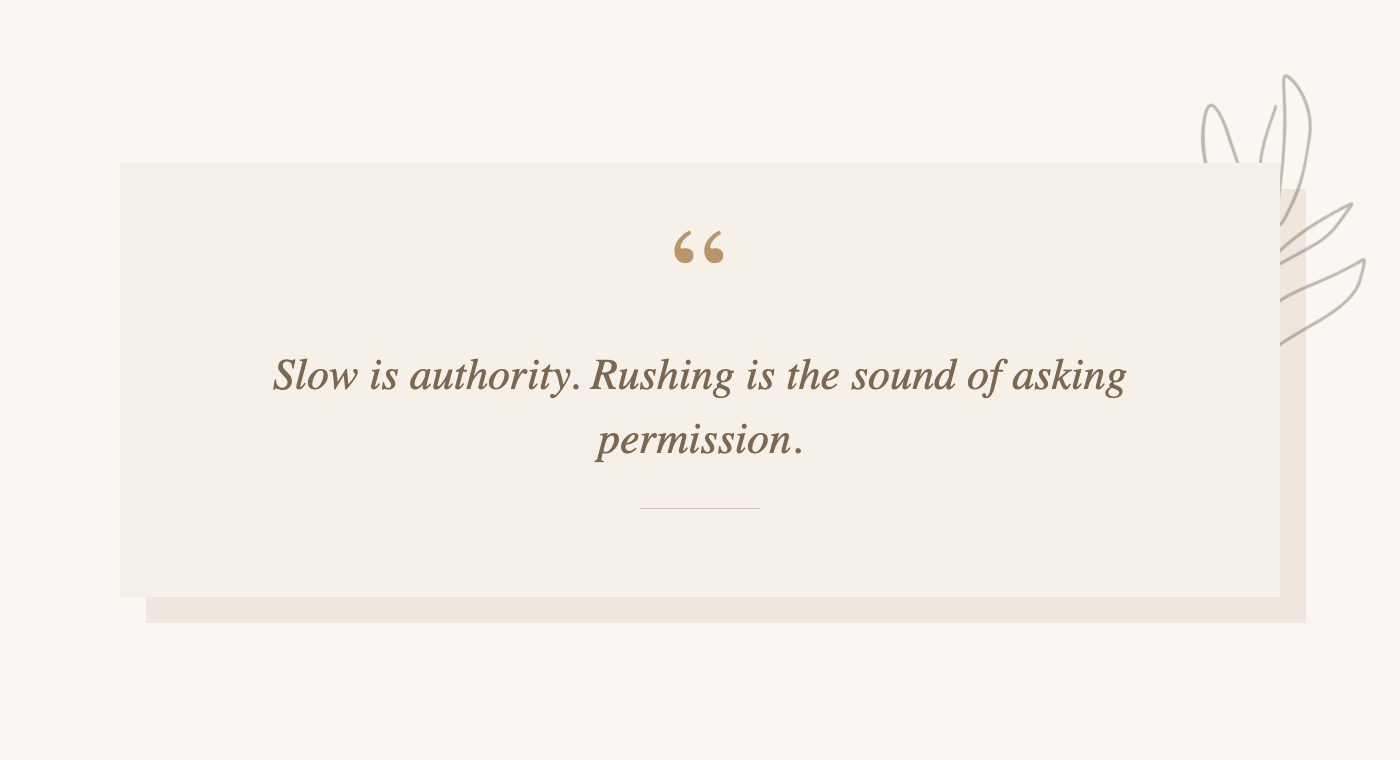
You don't need to talk like a hypnotist. Just take your natural speaking speed and ease off by about ten percent. It will feel strange in your body — almost too slow. On camera, it sounds exactly right. That gap between how it feels and how it sounds? Every actor learns to trust it. Now it's yours.
Lever three: the pause — it's not dead air
This is the one that changed everything for me as an actor, so lean in.
Amateurs fear silence. They pave over every gap with words, filler, nervous laughter — anything to keep the sound going. Professionals know the opposite is true: the pause is not dead air. The pause is emphasis.
On set, the most powerful moment in a scene is often the beat where nobody speaks. That's where the audience catches up. Feels something. Decides something. The silence is doing the work the words can't.
Your viewers need the same thing. When you say something that matters and then pause — one full second, maybe two — you're giving them time to absorb it. You're also sending a quiet signal: I'm not afraid of this silence. I'm choosing it. Nothing sounds more confident than that.
If silence still terrifies you, you're in good company — I wrote about making friends with your own recorded voice in why you hate the sound of your own voice, and the pause is where that healing starts.
Talk to one person, not at an audience
Here's the beautiful part: there's one shift that moves all three levers at once.
Most people speak at an imagined audience — a faceless crowd of judges on the other side of the lens. And the body responds to a crowd the way bodies always have: shallow breath, fast pace, no pauses. Fight or flight, in HD.
But when you talk to one person — one real, specific person you love — everything changes automatically. You breathe, because you're not in danger. You slow down, because you want them to understand. You pause, because you're actually waiting for them to take it in. That's what conversation is.
So before you press record, pick your person. Your sister. Your best friend. That one client whose face lights up when things finally make sense. Put them just behind the lens and tell them. The three levers will move on their own, because you've been speaking confidently to people you love your entire life.
This is the same reason your first line matters so much — if you've ever frozen on the opener, how to introduce yourself on camera walks you through it.
End your sentences like you mean them
One more lever, small but mighty: where your voice goes at the end of a sentence.
When we're unsure, we let sentences drift upward at the end — every statement curling into a little question? Like we're asking permission to have said it? You've heard it. You've probably done it. I certainly have.
Confident speech lands downward. The pitch settles at the end of the sentence, like a period you can hear. "This works." Not "this works?" Same words, completely different message.
You don't have to police every sentence. Just catch the ones that matter — your key point, your closing line — and let them land. Statement. Pause. Breathe. Next thought.
The thirty-second drill that proves it
Don't take my word for any of this. Run the experiment.
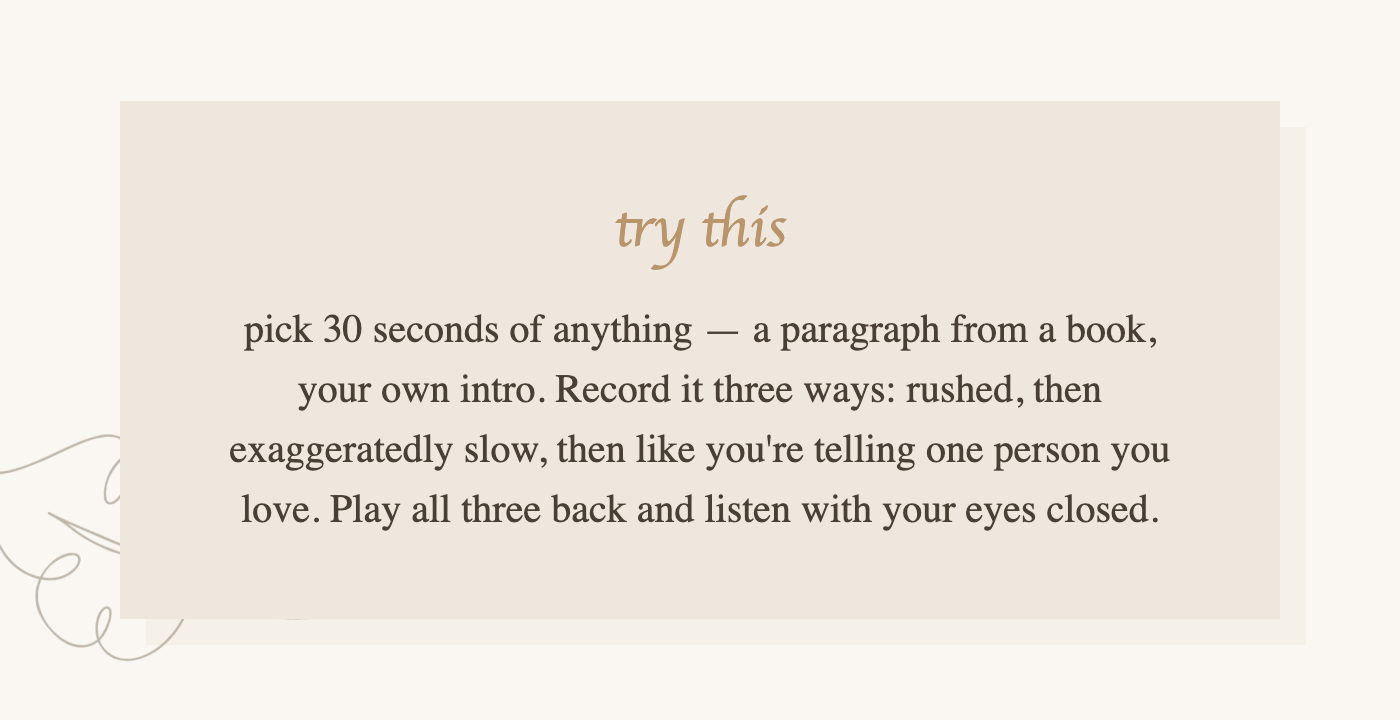
Take any thirty seconds of material and record it three times. First: rushed, the way nerves would have you do it. Second: deliberately, almost comically slow. Third: conversational — said to one specific person, with real pauses.
Then play them back with your eyes closed and just listen. I've never met anyone who couldn't hear the difference. Version one sounds like someone hoping to be excused. Version three sounds like someone worth listening to. Same words. Same voice. Same you.
That's the whole lesson, really. The confidence was in there the entire time — it was just being squeezed out by speed and shallow breath.
What happens when you slow down
This work goes deeper than technique, and I see it every week in our community. When people stop rushing, something settles — not just in their voice, but in how they carry themselves. A member put it this way after we worked together:
"Thank you Elfina for the work done during our sessions! You really know how to actively listen to people, and are able to instore a confidence mood right from the start. It's really useful to reframe things and start dealing with our limiting beliefs. Definitely book a session with Elfina to work on your confidence!"
— Sylvain Z.
That "confidence mood" he's describing? It isn't magic. It's what a room feels like when someone breathes, takes their time, and lets silence exist. You can build that room around yourself, one recording at a time.
And if you're not sure where you're starting from, the Camera Confidence Zone quiz takes two minutes and will tell you exactly which zone you're speaking from right now.
The myth of the naturally articulate speaker
Now for the belief that keeps most people stuck: "Confident speakers are just naturally articulate. I'm not, so this will never be me."
I've worked alongside actors the world calls effortlessly eloquent. Here's what I know from standing next to them between takes: they are not smoother thinkers than you. They fumble in rehearsal. They lose words at dinner like everyone else.
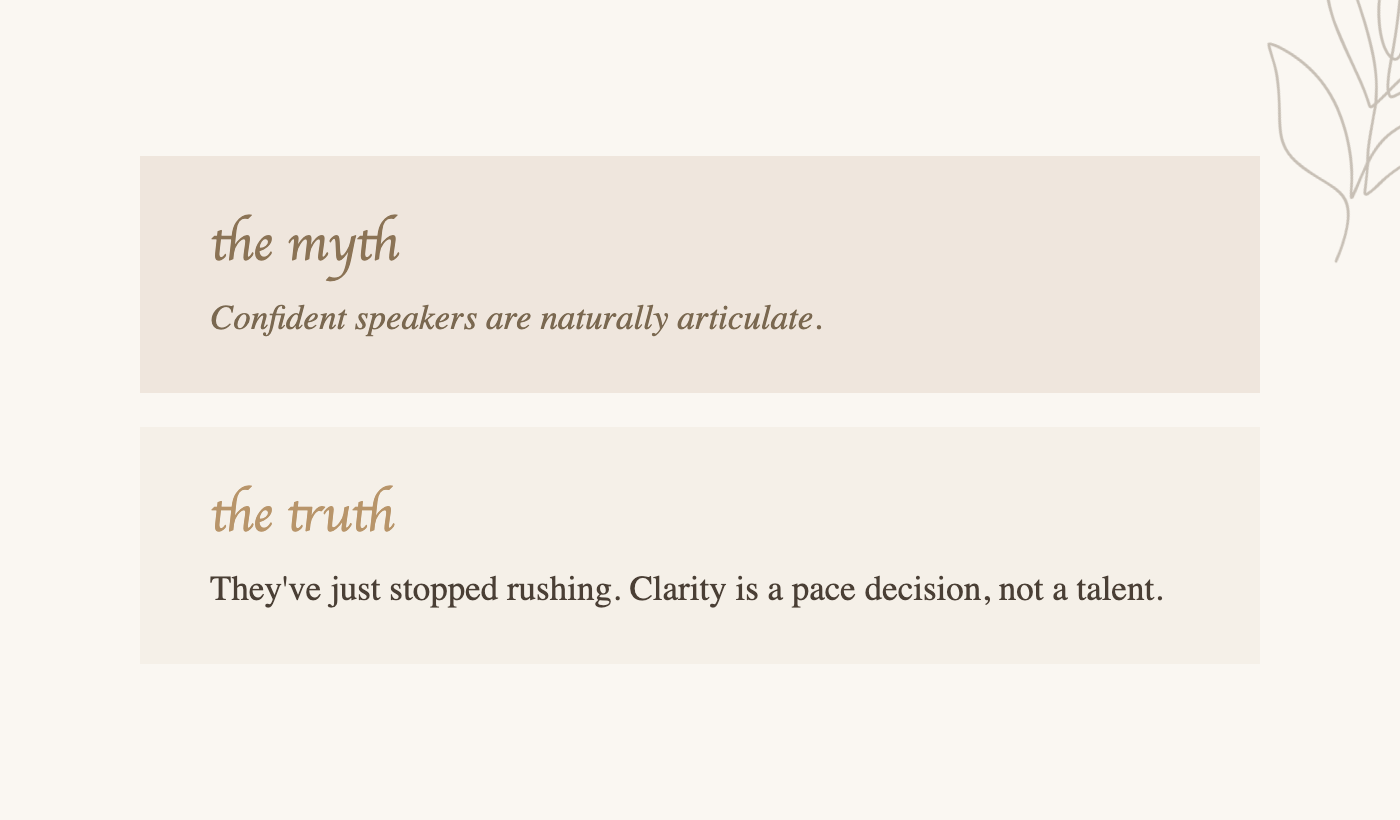
What they've done is stop rushing. That's it. When you slow down, your mouth finally moves at the speed of your mind — so the right word has time to arrive before you need it. What sounds like eloquence is usually just a person who refuses to sprint.
Clarity is a pace decision, not a talent. Which means it was never out of reach. It was just waiting for you to breathe.
Your voice is already enough
Here's what I want you to remember when you next press record: you already know how to speak confidently. You do it every time you comfort a friend, explain something you love, tell a story at the table. The levers — breath, pace, pause — aren't new skills. They're your natural voice, uncovered.
The camera didn't take that voice away. Fear of the camera did. And fear gets quieter every time you exhale, slow down, and talk to one person you love.
Be seen. Be heard. Be authentically you.
Pace and pauses get easier when you're not also working out what to say. Compass hands you the shape of it, so your voice has somewhere to sit.
See How It Works