For twenty years, professionals decided what I wore on camera. Here's everything they taught me — so you can settle this question in five minutes and never think about it again.
Every film I've ever worked on started the same way for me: a wardrobe fitting.
A rack of clothes chosen just for my character. A wardrobe designer with pins in her sleeve, narrowing her eyes at a shirt. And every so often, a top that looked perfectly lovely in the room would come off the rack, go in front of a camera test, and get quietly banished — because on screen it shimmered, or buzzed, or swallowed my face whole.
That's when I learned something that changed how I dress for every camera since: the camera does not see clothes the way a mirror does. It has opinions. Strong ones.
And then years later, there I was — no wardrobe department, no rack, just me standing in front of my own closet at home, about to film a video, changing my top for the fourth time and feeling my energy for the actual video drain away with every outfit change.
Sound familiar?
So this is that wardrobe fitting, for you. Everything a film wardrobe department knows about what to wear on camera, translated for one real person filming at home or showing up on video calls. It's shorter than you'd hope and simpler than you'd think. And at the end, I'll tell you the honest truth about how much any of this matters — because that part might be the most freeing thing in this post.
Not sure where you’re starting from? Find your Camera Confidence Zone — it takes two minutes.
What to wear on camera: think like a wardrobe department
A wardrobe designer isn't asking "is this fashionable?" They're asking one question: does this help or fight the camera? Once you know what the camera struggles with, the rules almost write themselves. There are only four.
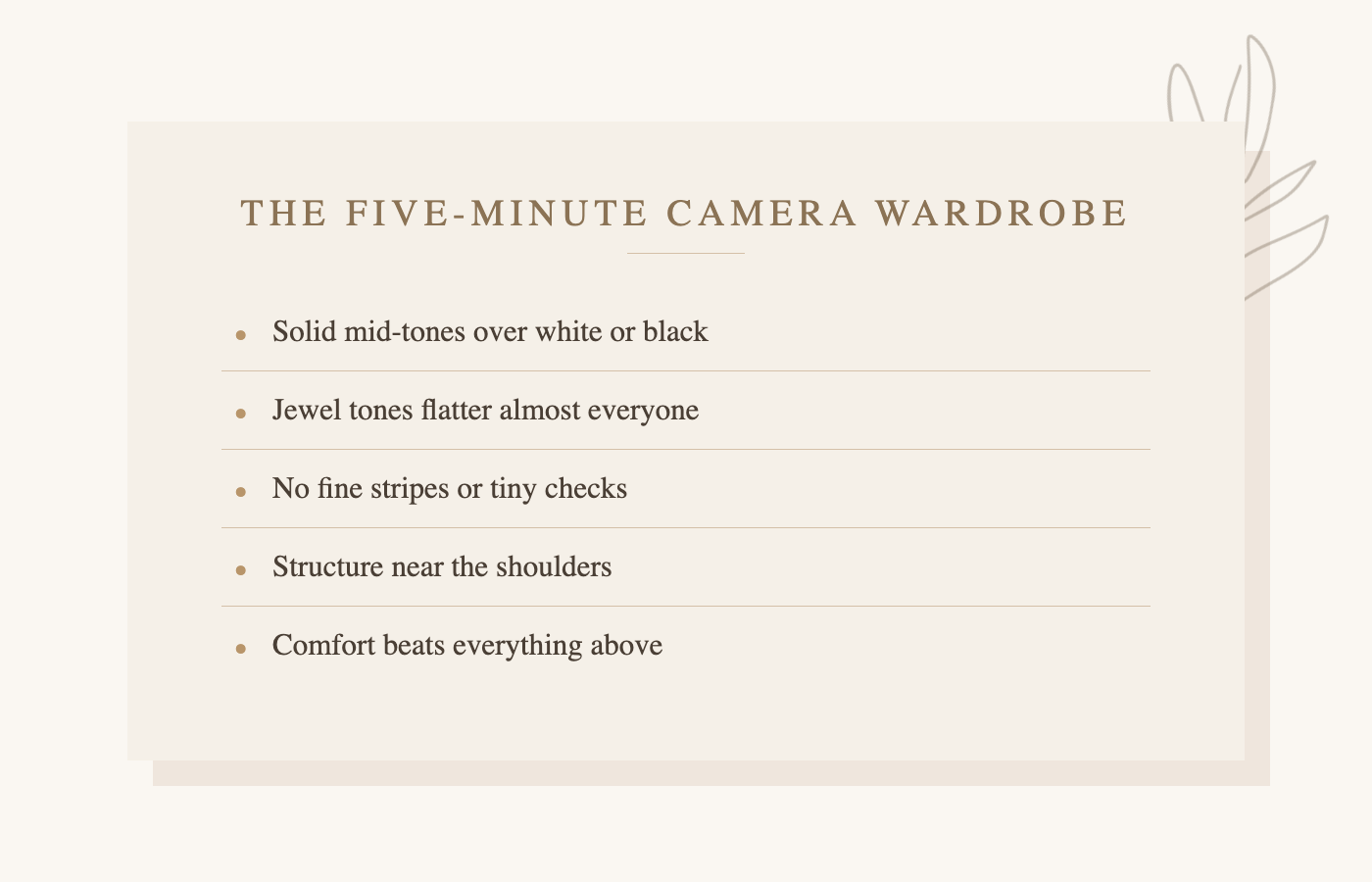
1. Solid mid-tones are your best friend
The safest, most flattering thing you can wear on camera is a solid colour in the middle of the brightness range — not white, not black, but the enormous friendly territory in between.
Here's why, and it's not a style opinion, it's physics. A camera has to choose one exposure for the whole frame. Pure white is so bright it tends to "blow out" — it becomes a glowing shape with no detail, and the camera dims everything else (including your face) to compensate. Pure black does the reverse: it collapses into a void, and your face becomes the brightest thing in frame, shine and all. The camera spends the whole video refereeing between your outfit and your face.
A mid-tone — teal, rust, olive, burgundy, dusty blue, warm grey, forest green — lets the camera relax and expose for the thing that matters: you.
2. Jewel tones flatter almost everyone
If you want the short answer to "which colour, though?" — jewel tones. Emerald, sapphire, teal, amethyst, deep ruby. These rich, saturated mid-tones have been the on-camera reliables for decades because they do two jobs at once: they sit comfortably in the camera's exposure range, and they reflect a little richness back up into the face. Most skin tones look more awake next to a jewel tone.
You don't have to go bold to get the benefit. A deep teal sweater is not a statement. It's just quietly on your side.
3. Skip the fine stripes, small checks, and busy prints
This is the one that got shirts banished at my fittings. Fine, tight patterns — pinstripes, small checks, herringbone, tiny florals — collide with the grid of pixels in a camera sensor and create a shimmering, rippling effect called moiré. The fabric looks like it's vibrating. It's distracting on a big production camera and worse on a webcam, and no amount of good lighting fixes it, because it's not a lighting problem. It's a pattern-versus-pixels problem.
Big, bold patterns are fine, if they're you. It's specifically the small, tight, repeating ones that buzz. When in doubt: if you'd have to stand close to see the pattern, the camera will struggle with it.
4. Fit beats fashion
Here's something wardrobe departments understand that fashion magazines don't: a talking-head video is mostly a rectangle of you from the chest up. In that frame, what reads isn't the label or the trend — it's the line of your shoulders and neckline.
A little structure up top — a jacket, a collar, a well-fitting crew neck, a top with actual shoulders in it — gives that rectangle a clean, intentional shape. Very slouchy, very oversized pieces, lovely as they are in real life, tend to read as a shapeless mass on camera because the frame cuts off all the context that makes them make sense.
Notice what this rule is not: it's not "dress up." It's not "wear a blazer." It's just: in a small frame, shape reads. Choose one thing with a bit of structure and you're done.
Comfort is a confidence tool, not a compromise
Now the rule that outranks the other four.
Wear the thing you forget you're wearing.
Because here's what I know from twenty years of being filmed: the camera picks up fidgeting the way a microphone picks up whispering. A waistband that pinches, a collar you keep adjusting, a top you're secretly worried is gaping — every one of those tiny distractions pulls a thread of your attention away from the person you're talking to. And attention is the whole game. The moment you're managing your outfit, you've stopped connecting.
This is why I'll take a plain, comfortable, mid-tone top over a stunning-but-fussy one every single time. Comfort isn't settling. Comfort is a performance choice. On set we called clothes like that "worn in" — pieces that let the actor disappear into the person they were playing. You're not playing anyone. You get to disappear into yourself.
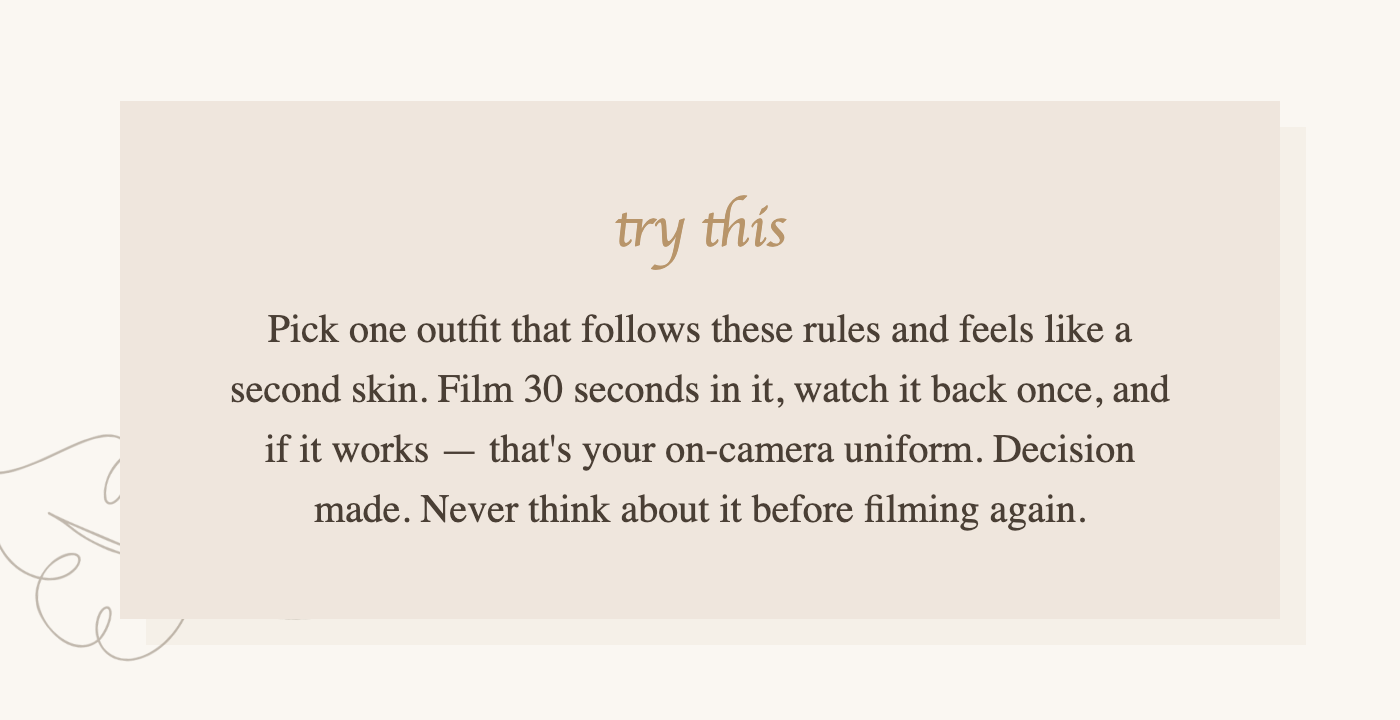
My honest suggestion: choose an on-camera uniform. One or two outfits that pass the rules and feel like nothing on. Hang them together. Then, when it's time to film, there is no decision to make — and every drop of energy you used to spend in front of the closet goes into what you actually want to say.

The honest part: your outfit is the least interesting thing about your video
Can I tell you something that took me embarrassingly long to accept, even as a professional actor?
Nobody is watching your video for your outfit.
They're watching for you. Your warmth, your ideas, the feeling that you're talking to them. In every piece of footage I've ever reviewed with a nervous creator, the thing that made it work or not work was never the top they chose. It was whether they were present or performing.
So why does this post exist? So you can stop thinking about it. That's the entire purpose of getting wardrobe right — not to be looked at more, but to be worried about less. Settle the clothes question once, and it stops being the excuse between you and pressing record. If you want the same peace of mind about your lighting and setup, I've written that guide too: how to look good on camera — same philosophy, decide once, then forget it.
What actually changes when you stop thinking about it
A member of our community, Kat, put it this way:
"Before her program, I felt like a robot in front of the camera. I would blank out and block my own way to progress. After, I easily let my personality shine through, while getting what I want the content to convey across! 10/10, thanks again Elfina!"
— Kat O.
Notice what shifted for her. Not the closet. The blanking out, the self-blocking — the attention trapped on herself instead of flowing toward the person watching. That's the real work, and wardrobe is just one of the places we quietly hand that attention away. Every rule in this post is really the same rule: remove one more thing that pulls you out of the moment.
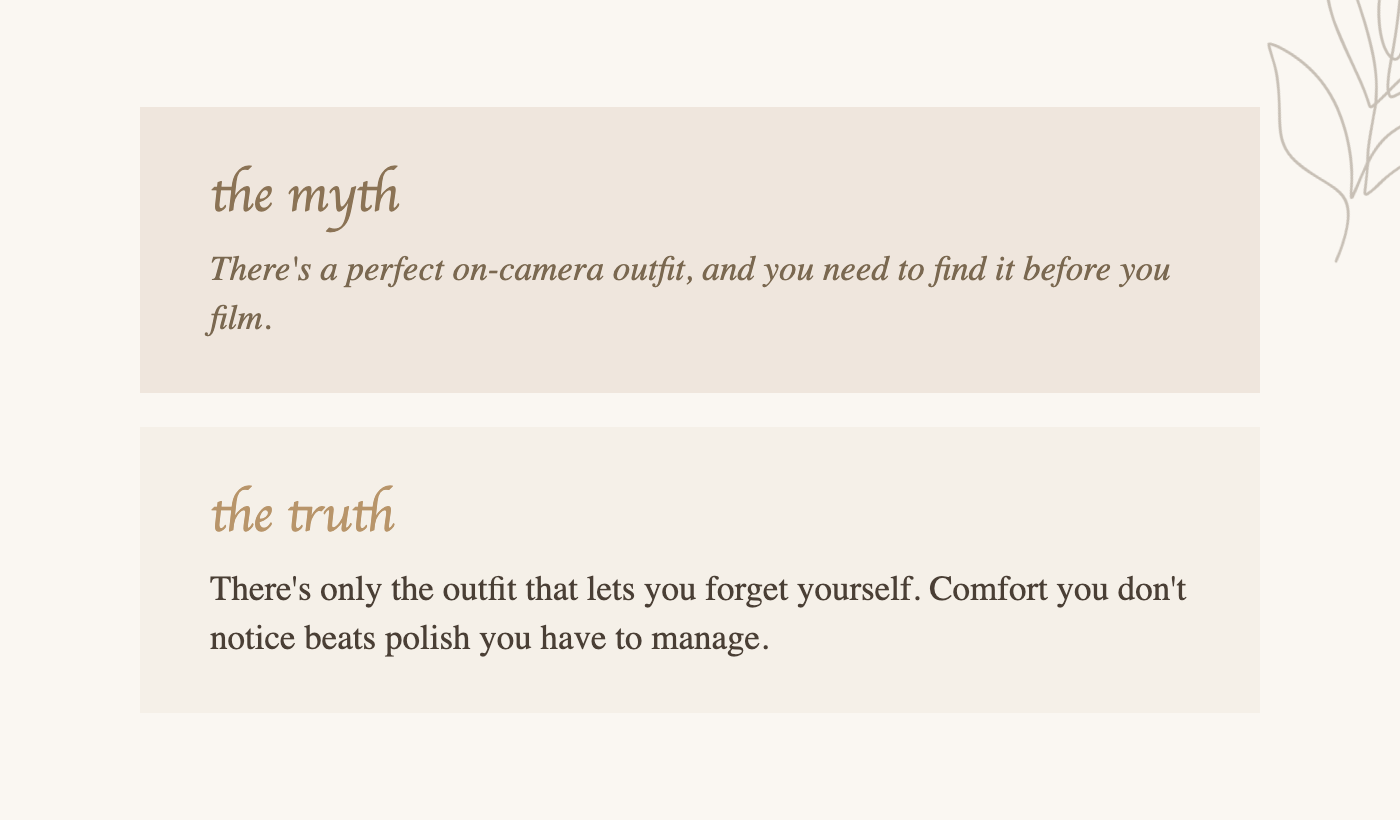
The myth: there's a perfect on-camera outfit
Somewhere out there, the myth goes, is The Outfit. The one that will make you look polished and credible and finally ready — and until you find it, well, better not film yet.
I've stood in front of racks assembled by brilliant professional wardrobe designers, and I can tell you: even there, there was no perfect outfit. There were outfits that served the story and outfits that got in its way. That's the entire measurement.
The truth is simpler and kinder: there's no perfect on-camera outfit — there's only the outfit that lets you forget yourself. The moment you stop feeling your clothes is the moment your message gets all of you. A solid jewel-tone top that fits, no busy pattern, comfortable enough to disappear. That's it. That's the whole secret the fittings taught me.
Get dressed, then go be seen
Solid mid-tone. Jewel tones if you want a lift. Nothing tiny and repeating. A little shape up top. And above everything: clothes you forget the moment the camera rolls.
Five minutes in your closet, one uniform on a hanger, and this question is answered for good. Which means the next thing between you and the record button isn't fabric anymore. It's just the being-seen part — and that one, we can work on together.
If you're curious where you actually are on that journey, the Camera Confidence Zone quiz takes three minutes and meets you exactly where you are.
Be seen. Be heard. Be authentically you.
Two minutes, a handful of honest questions, and you'll know exactly which zone you're in — and what to work on next.
Take the QuizPractise everything in this post alongside people cheering you on — that's what the community is for.
Join the Community