
The first time I counted the "ums" in one of my own videos, I stopped at thirty-one. Thirty-one. In under four minutes.
I remember sitting there with my tea going cold, cursor hovering over the delete button, thinking: I've been a professional actor for two decades. I deliver other people's words for a living. How is this my mouth?
Maybe you've had that moment too. You watch yourself back, and suddenly that's all you can hear. Um. Uh. So. Like. You know. Each one lands like a tiny verdict: amateur.
So you do what everyone does. You google how to stop saying um, you find a list of stern rules, and next recording you're so busy policing your own mouth that you sound like a hostage reading a statement. Congratulations: fewer ums, way less you.
There's a better way. It's gentler, it actually works, and it starts with calling off the hunt.
Your "um" is not a flaw — it's your brain buying time
Here's the reframe, and I need you to really take it in: filler words are not a character defect. They're a timestamp. An "um" is simply the sound of your brain reaching for the next thought and holding the microphone while it looks.
Everyone does it. Every language on earth has its version — the French say "euh," the Japanese say "eto." It's as human as blinking.
Which is why the hunt-every-um approach backfires so badly. When you turn your attention inward — monitoring, judging, flinching at every syllable — you create exactly the kind of tension that produces more fillers. And worse: the viewer can feel you watching yourself. That self-surveillance reads as stiffness, and stiffness costs you far more trust than an "um" ever will.
So here's our actual goal, and I want to be precise about it: fewer, not zero. A sprinkle of human filler in a warm, present delivery beats a spotless robotic one every single time. We're not deleting you. We're just giving your brain a quieter way to buy its time.
Not sure what to film next? Creative Compass builds the plan with you.
How to stop saying um: swap it for the silent pause
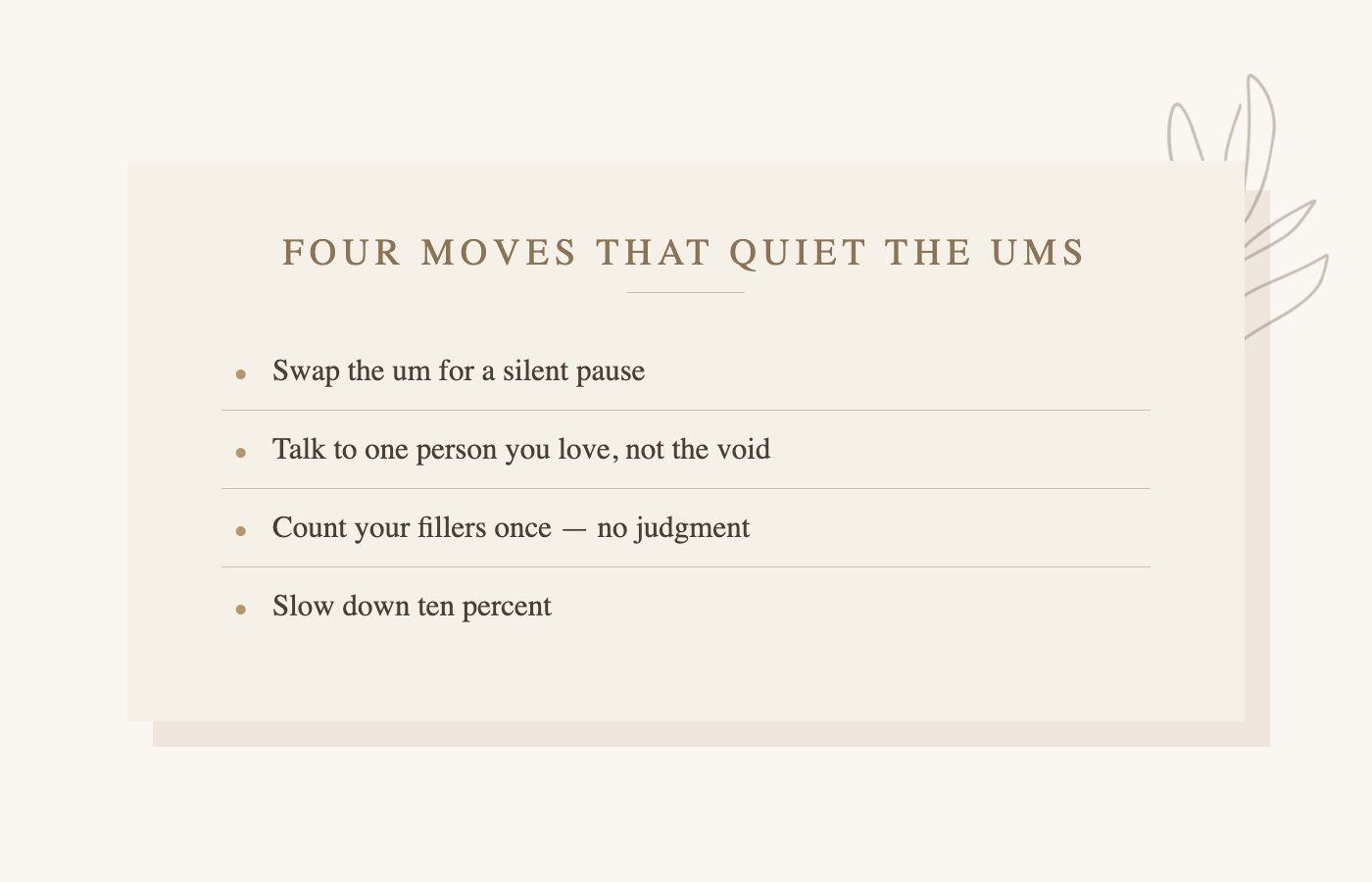
Ready for the entire secret? Here it is: the "um" and the pause are the same thing. Same length. Same function. Same little gap while your next thought arrives. The only difference is the soundtrack.
One is filled with a nervous hum. The other is filled with silence. And those two versions of the exact same moment read completely differently to a viewer. The um says I'm uncomfortable with this gap, please excuse me. The silent pause says I'm thinking. Stay with me. One leaks status; the other builds it.
Actors live on this. Watch any actor you love in an interview — off-script, no lines to lean on. When they reach for a thought, they don't fill the reach. They let it be quiet. Sometimes they even look away for a beat, find the thing, and come back. It doesn't read as blankness. It reads as depth.
So the practice is beautifully simple: when you feel an "um" coming — that little pressure at the front of your mouth — just... don't voice it. Keep your lips together. Let the gap be a gap. Your thought arrives on schedule either way; you've just stopped narrating the wait.
Will you catch every one? No. You don't need to. Catch some. The rest are proof you're a person.

Why the ums multiply the moment the camera turns on
Have you noticed you say more fillers on camera than you ever do at dinner? There's a real reason, and it isn't that you suddenly got less articulate at the press of a record button.
In real conversation, the person in front of you paces you. Their nods, their little "mm-hms," the light in their eyes — that feedback is a metronome. Your brain relaxes into their rhythm, and the gaps get shared. Conversation is a duet.
A lens gives you nothing. No nods. No rhythm. Just a small black void where a face should be. And your brain — which has spoken to people its whole life — panics quietly in the vacuum and starts stuffing every silence with sound, because silence with no listener feels like falling.
The fix isn't more discipline. It's giving your brain back its duet partner. Before you record, pick one person you love — your sister, your oldest friend, that client you adore — and speak to them through the lens. Actually picture them nodding.
I've watched this one shift cut people's fillers nearly in half without them trying, because the ums were never a speech problem. They were a loneliness problem. This is the same shift that unlocks pace and breath too — I go deeper on it in how to speak confidently on video.
The awareness rep: count them without judgment
Now for the drill that sounds too small to work, and works anyway.
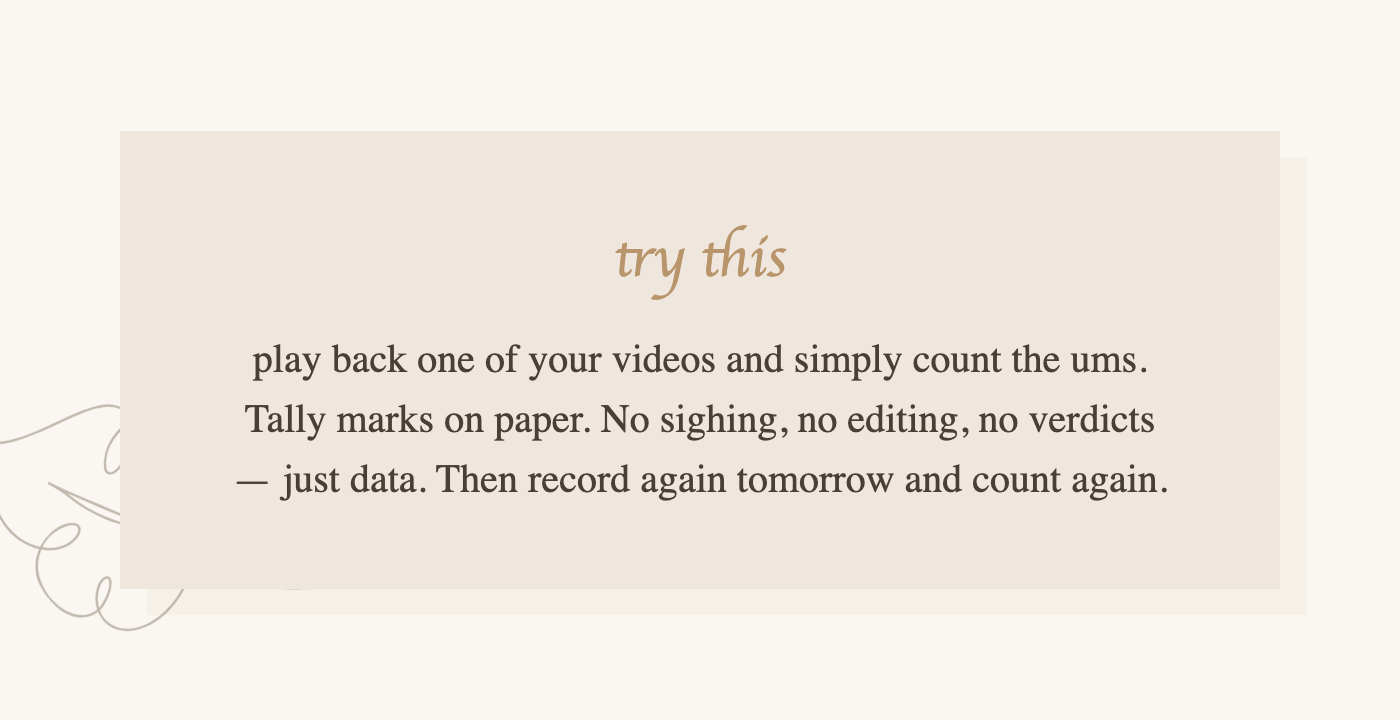
Pick one video of yourself — an old one is fine. Play it back, and just count the fillers. Tally marks on a scrap of paper. That's it. No wincing, no self-lecture, no "ugh, I'm the worst." You're not a judge here; you're a scientist collecting data.
Here's why this works: most of our fillers are completely unconscious. We literally don't hear ourselves say them. Counting drags them into awareness — and speech habits, once you can actually hear them, start correcting on their own. No forcing required. The number drops the very next time you record, because part of your brain is now gently listening for them.
The "without judgment" part is not decoration, by the way. It's the mechanism. Judgment creates tension, tension creates fillers, and around we go. Neutral attention breaks the loop. If watching yourself back makes your skin crawl — I know, believe me, I know — I wrote how to watch yourself on video without cringing for exactly that.
Slow down ten percent and watch them fall away
One more lever, and it might be the easiest of all: speed.
Fillers thrive on rush. When you're talking faster than you're thinking, your mouth keeps arriving at gaps before the next thought does — and it plugs each gap with an um. It's not a vocabulary shortage. It's a timing mismatch.
So slow down. Just ten percent — barely noticeable from the outside, though it will feel almost lazy from the inside. At that pace, your thoughts run ahead of your mouth instead of behind it, the next word is ready when you reach for it, and the ums quietly lose their job.
Rushed speech plus fillers reads as nervous. Unhurried speech with a few honest pauses reads as someone worth listening to. Same person. Same content. Ten percent.
What it feels like when the pressure lifts
I want you to hear what this gentler road actually sounds like from the other side, because "stop policing yourself" can feel almost too soft to trust. A member put it this way:
"I've had the pleasure of working with Elfina over the past few months and have made unexpected, meaningful progress. She creates a safe space where I can share at my own pace, offering invaluable insights into the barriers in my life that have held me back from reaching my full potential, both as an artist and as a person. Her approach is unique and transformative."
— Claudia Chen
"At my own pace." That's the whole thing, isn't it? The ums were never really the problem — the pressure was. When you give yourself permission to take your time, on camera and off, the fillers loosen their grip on their own.
If you're curious where that pressure is coming from for you specifically, the Camera Confidence Zone quiz will show you in about two minutes.
The myth: great speakers never say um
Let's retire the belief underneath all this anxiety: "Really good speakers don't say um."
They do. I promise you they do. Put on any unscripted interview with a speaker you admire — an actor on a late-night couch, a scientist on a podcast, a president off the teleprompter — and listen closely. The ums are there. The "you knows" are there. Your brain just doesn't register them, because the speaker isn't flinching at them.
That's the real difference. It was never that great speakers eliminated their fillers. It's that they made peace with the pause — so the occasional um floats by unnoticed in a delivery that feels calm, warm, and sure. Polish was never the goal. Presence was.
And presence, my friend, is not a gift some people are born with. It's what's left of you when the self-policing stops.
Let the gap be a gap
So here's your homework, and it's kind: watch one video, count the ums like a scientist, and next time you record, talk to one person you love — ten percent slower — and let the gaps stay silent when you can.
Not zero ums. Fewer. With more of you in between them.
Because the world doesn't need a more robotic version of you. It needs the real one, thinking real thoughts, unafraid of a second of silence.
Be seen. Be heard. Be authentically you.