
Here's the paradox nobody warns you about: you sound scripted because you're trying to get the words right.
I've watched it happen on real sets, with real actors, more times than I can count. Take one: alive, a little messy, electric. Then somebody flubs a line, and the next few takes become about the words. Getting them right. Getting them in order. And you can feel the scene die in real time — same script, same talented person, and suddenly it's cardboard.
The director doesn't say "you got a word wrong." The director says "you went into your head."
Now think about your last video. You wrote it out, or at least rehearsed it a few times in the shower. You hit record. And somewhere between your brain and your mouth, you turned into a slightly formal stranger — a customer-service version of yourself, reading an internal teleprompter. You watched it back and thought: why do I sound like that?
If you've been searching for how to not sound scripted on camera, I can tell you exactly why you sound like that. And I can tell you what actors — people whose entire job is saying pre-written words believably — actually do about it.
Reading and talking are two different languages
Here's the reframe: the problem was never your delivery. It's that reciting and talking are two different registers — almost two different physical activities — and every human alive can tell them apart instantly.
When you talk, your brain is building thoughts in real time. The melody wanders. Emphasis lands on the words you mean. Little imperfections — a restart, a "well," a laugh — ride along naturally, because you're focused on the person you're talking to.
When you recite, your brain is doing something else entirely: retrieving. Checking each phrase against a stored copy. And retrieval has a sound — flattened melody, evenly spaced words, emphasis in slightly wrong places. Your viewer can't name it, but they clock it in about two seconds: this person isn't talking to me. They're performing a memory.
And here's the part I need you to accept, because it changes everything: you cannot polish your way out of this. More rehearsal of the exact words makes the retrieval groove deeper. The way out isn't through the script. It's away from it.
Not sure what to film next? Creative Compass builds the plan with you.
How to not sound scripted: pursue the intention, not the words
Let me tell you the actual secret of actors, because it's the opposite of what most people assume.
Good actors don't recite lines. Yes, we learn them — cold — but when the camera rolls, the words are not what we're thinking about. We're pursuing an intention: what my character wants from the other person in this moment. To comfort her. To warn him. To make her laugh so she stays. The line is just the tool; the want is the engine. That's why the same script sounds alive in one actor's mouth and dead in another's.
Twenty years on set, and this is still the whole job: know what you want the other person to feel, and let the words serve that.
Now bring that to your videos. Before you press record, don't ask "what am I going to say?" Ask: "what do I want the person watching to feel by the end of this?" Relieved? Braver? Understood? Curious? Pick one. Write it at the top of your notes if you like — not to say out loud, but to aim at.
When you speak from a want instead of a script, your voice does everything the rehearsed version can't: the melody comes back, the emphasis lands where your heart puts it, and your face wakes up. Because now you're doing the thing humans have always done — trying to reach someone — instead of trying to remember something.

The bullet method: three bullets, never sentences
"Okay, Elfina, but I can't just wing it. I ramble."
I hear you. Structure is good. Scripts are the problem, not preparation. So here's the preparation that works:
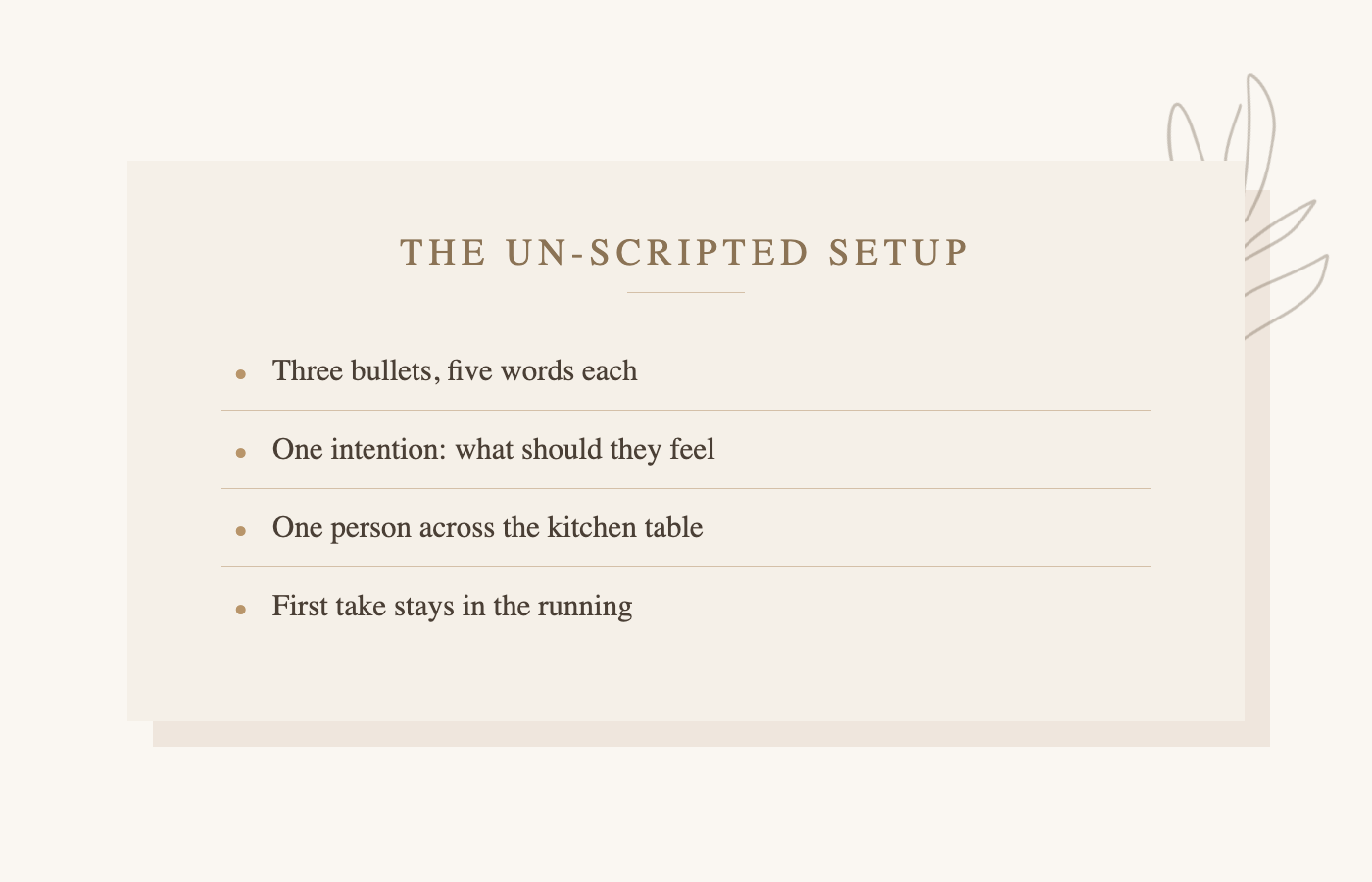
- Write three bullets. Not sentences — bullets. Three short fragments, each one a landmark: where you start, the one thing that matters most, where you land. If a bullet is longer than five or six words, it's secretly a script. Trim it.
- Say your one-feeling intention out loud once. "I want her to stop being so hard on herself." That's your compass for the whole take.
- Then talk. Glance at a bullet, look back at the lens, and say that idea the way it comes out right now. The phrasing will be different from how you'd write it. That's not a bug. That's the sound of talking.
Why bullets work: sentences store wording, so your brain retrieves. Bullets store meaning, so your brain has to build the wording fresh — which is precisely the thing that sounds human. You're forcing yourself into the talking register because there's nothing to recite.
Say it across the kitchen table
Bullets give you the words. This next piece gives you the sound.
Picture one person you love — not "my audience," not "my followers," one actual person. Your best friend. Your mom. That one client whose questions you could answer for hours. Now imagine the two of you at your kitchen table, tea in hand, and they've just asked you about exactly this topic.
You would not clear your throat and begin a presentation. You'd lean in and tell them. Your whole instrument shifts — warmer tone, natural pace, real pauses, eyebrows that move. Actors call this "playing to a scene partner," and it's why we're taught to never act at a camera; the lens is always a person. Make it that person, every take.
This shift also transforms your pace and your pauses — the levers I break down in how to speak confidently on video — but here, its job is simpler: you cannot sound scripted while genuinely telling a friend something. The registers can't coexist.
Let the imperfect phrasing live
Now, the hard part. When you talk instead of recite, imperfections happen. You'll restart a sentence. Use a "wrong" word and correct it. Laugh at yourself. Trail off and come back.
Your inner perfectionist will scream cut, redo it. Please don't listen. Because here's what I know from two decades of watching dailies: the "flaws" are the humanity. The little restarts and rough edges are the exact texture that tells a viewer's nervous system this is a real person, in real time, actually talking to me. Sand them all off and you've sanded off the trust.
I came to this the hard way. Perfectionism ran my life for years — it kept me quiet, kept me redoing, kept me hiding behind "one more take." What finally freed me wasn't getting better at being flawless. It was noticing that the moments people responded to, in my work and in me, were never the polished ones. They were the true ones. If that battle sounds familiar, how to be yourself on camera is the deeper dive.
Which brings me to the first-take rule: take one is usually the most alive. Before your inner editor wakes up, before you start "fixing," there's a take where you're just telling someone something. It may have a stumble. Keep it in the running anyway. When you compare it to take nine, listen for aliveness, not accuracy — you'll be surprised how often take one wins.
One of our members came to me with exactly this block, and here's what she found on the other side of it:
"Before her program, I felt like a robot in front of the camera. I would blank out and block my own way to progress. After, I easily let my personality shine through, while getting what I want the content to convey across! 10/10, thanks again Elfina!"
— Kat O.
That "something blocking me" she describes? Nine times out of ten, it's this: the belief that the polished version of you is the acceptable one. It isn't more acceptable. It's just less you. (If you want to see where your own block lives, the Camera Confidence Zone quiz will point right at it.)
The myth: "if I rehearse enough, I'll sound natural"
Let's take down the belief that's been driving the whole spiral: "I sound scripted because I haven't practiced enough. A few more run-throughs and it'll finally sound natural."
I understand why you believe this — it's how everything else works. More practice, better piano. More reps, stronger squat. But naturalness runs backwards: more rehearsal of the exact words makes you sound less natural, not more. Every run-through moves the material further from "thing I'm telling you" and closer to "thing I'm reciting from storage." You're not smoothing the take; you're laminating it.
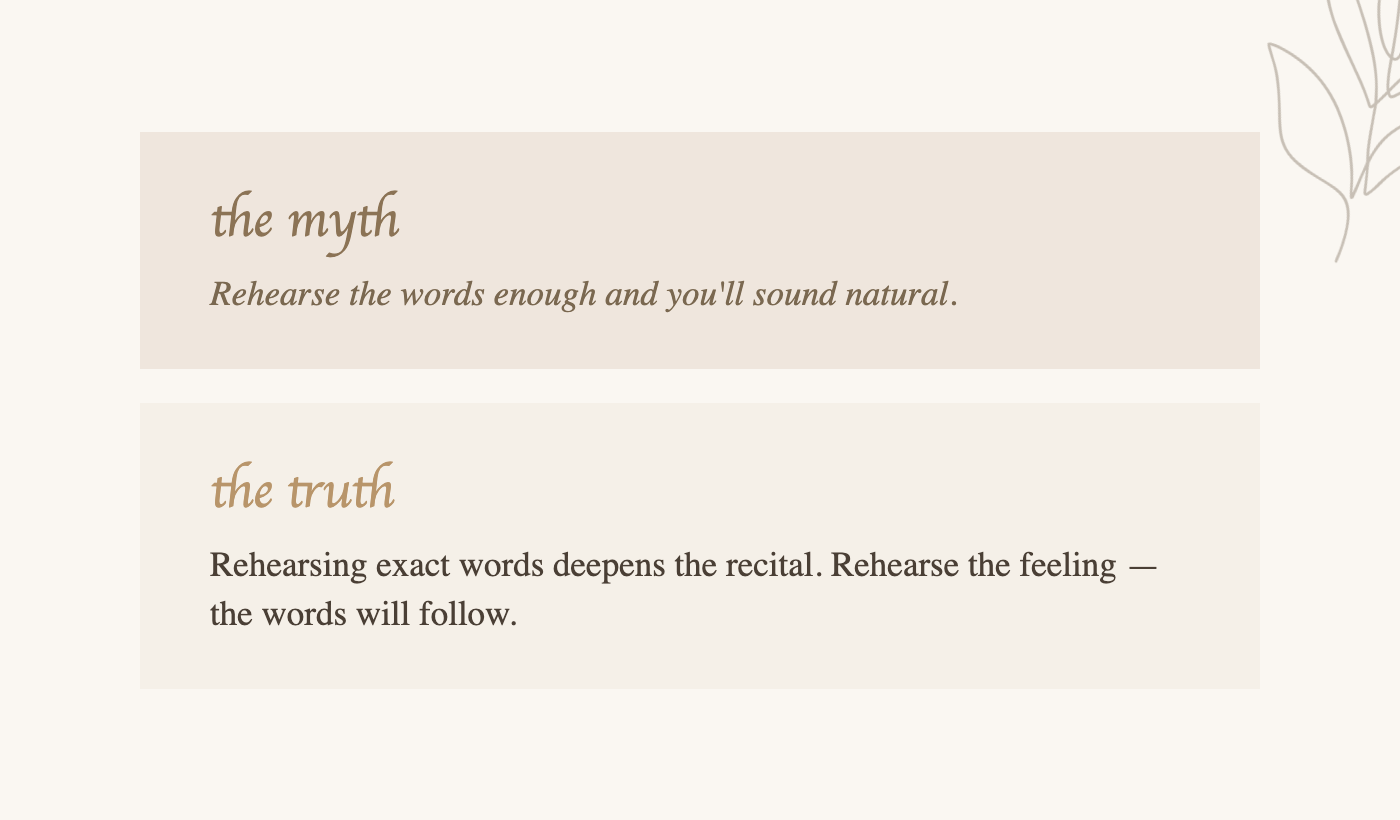
So what do you rehearse? The feeling. Sit with your intention until it's real to you — until you actually care that your viewer leaves braver, or lighter, or clearer. Know your three landmarks. Then trust that you, a person who has talked successfully for your entire life, will find words when there's a real want behind them.
Actors spend years learning to make written words sound spontaneous. You have a shortcut we'd envy: you don't have to say anyone else's words. You get to just talk.
You were never meant to be memorized
So here's the whole thing, small enough to tape to your camera: What do I want them to feel? Three bullets. One person. Kitchen table. Keep take one.
The version of you that wanders, restarts, laughs mid-sentence, and lands the point with slightly imperfect words — that's not the rough draft of your on-camera self. That is your on-camera self. The scripted one was the impostor all along.
Be seen. Be heard. Be authentically you.